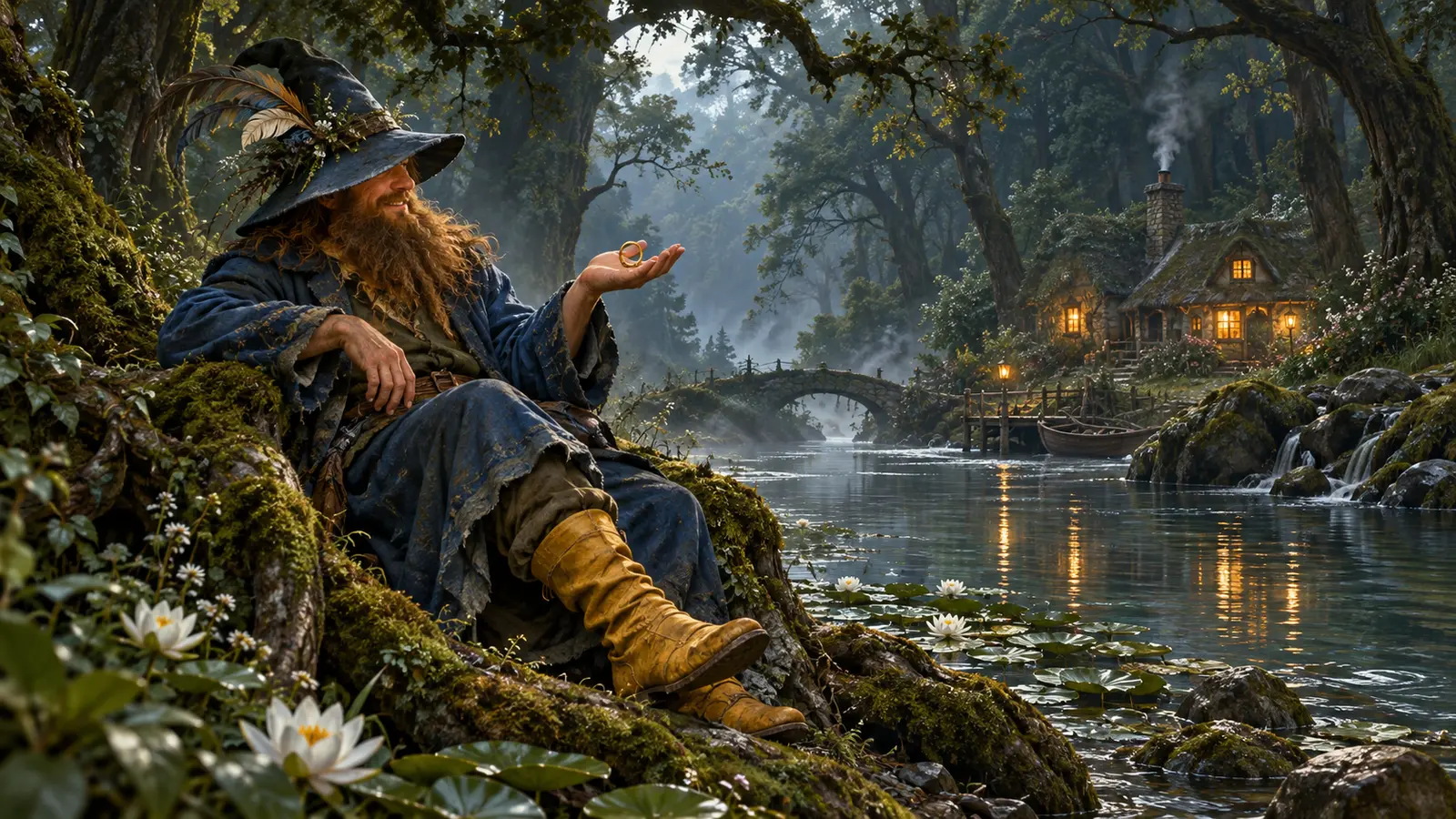
There are many frightening moments in The Lord of the Rings, but one of its strangest is almost comic. In the house beside the Withywindle, Frodo hands the One Ring to Tom Bombadil. Tom places it on his finger and does not disappear. He makes it vanish for a moment, brings it back, and when Frodo later puts it on, Tom can still see him. The object that has already begun to press upon Frodo’s mind appears to be no more dangerous to Tom than a trinket found beside the road.
This scene has encouraged decades of theories. Is Tom a Vala, a Maia, the embodiment of nature, or even a figure standing outside the created order? Tolkien resisted every attempt to settle the question so neatly. Tom is not a puzzle with one concealed answer. He is an intentional enigma, placed near the beginning of the journey to show us that Middle-earth is older, larger and less obedient to our explanations than the central conflict alone can contain.
Yet Tolkien is not vague about the Ring’s failure. At the Council of Elrond, Gandalf says, “Say rather that the Ring has no power over him. He is his own master.” The distinction matters. Tom does not defeat the Ring in a contest of strength. Its promise simply finds nowhere to fasten.
The Ring offers more than invisibility
To understand Tom’s freedom, we must first remember what the Ring actually does. Its most visible effect on mortals is to draw the wearer into the Unseen world, making the body disappear from ordinary sight. But invisibility is not its deepest power. The Ring was made by Sauron as an instrument of domination, carrying his will to order other minds beneath his own.
Its temptation therefore changes according to the person who approaches it. It does not offer Boromir a private hiding place; it offers him the strength to defend Gondor and become the saviour his people need. Galadriel imagines a realm ordered beneath a beloved and terrible queen. Sam, for one brief moment, sees gardens spreading over a conquered waste. The visions differ, but the movement beneath them is the same: take this power, impose the good as you understand it, and let no other will stand in the way.
The Ring can work through noble motives because noble motives may still conceal possessiveness. The desire to protect can become the desire to control; stewardship can quietly become ownership. Its lie is not always that evil is beautiful. Often it is that the good can be secured if only we are willing to force it.
Tom’s mastery is the refusal to possess
Tom lives by a different grammar. Goldberry calls him master, but she immediately denies the meaning that word usually carries. The trees, grasses and creatures of the Old Forest do not belong to him. They belong to themselves. His mastery is not proprietorship; it is a freedom so complete that he can know, name and delight in things without needing to own them.
This is why the Ring’s offer is empty in his hands. It can magnify ambition, fear and the wish to arrange the world around oneself, but Tom does not want a larger realm. He does not desire servants, monuments or even the extension of his good influence. His country has boundaries, and he keeps them without anxiety. He sings to willow, water and stone because he attends to what each thing is, not because he wishes to turn everything into an echo of himself.
Tolkien’s letters help us approach this without dissolving the mystery. In Letter 144, written in April 1954, he describes Tom as representing a mode of natural knowledge marked by delight rather than control. In Letter 153, written later that year, he insists that Tom should remain an unexplained fact within the story. The point is not to assign him a rank in a celestial chart. It is to recognise a way of being almost wholly free from the will to possess.
That freedom makes Tom more than comic relief. The Ring is the great symbol of coercive power in Middle-earth, and Tom exposes its poverty. Before him, its most seductive promises are reduced to a small circle of gold. He does not conquer it. He simply has no use for what it is selling.
Why Tom is not the answer
If Tom is immune, the obvious question follows: why not leave the Ring with him? The Council of Elrond considers exactly this. The answer is one of Tolkien’s most important distinctions. Freedom from temptation is not the same as fitness for responsibility.
Gandalf believes Tom might accept the Ring if everyone asked him, but he would not understand the need to guard it. He might forget it, mislay it or throw it away. This is not because he is foolish in an ordinary sense. The Ring’s importance belongs to a struggle Tom has deliberately not made his own. What consumes kings, wizards and armies remains peripheral within the small country where his songs have power.
Nor could he stand forever against Sauron. If every other defence fell, Tom’s land would fall last, but it would fall. His immunity does not give him the power to destroy the Ring, heal those it has wounded or prevent the Enemy from taking it by force. He is beyond its inner persuasion, not beyond the reach of history.
Here the contrast with Frodo becomes sharp. Frodo is not immune. He feels the Ring’s weight, hides it, fears for it, and at the final moment cannot freely surrender it. Yet he can bear it toward the Fire because he loves people and places inside the world’s peril. The Shire is not an abstract landscape to him. It is a home that can be wounded. His vulnerability is part of what makes his costly obedience possible.
Tom shows what it is to be untouched by domination. Frodo and Sam show what it is to accept responsibility while still being woundable. Middle-earth needs both visions, but only the second can take the road to Mordor.
The boundaries of innocence
Tom is not indifferent to suffering. He rescues the hobbits from Old Man Willow, shelters them through rain and fear, and comes again when the Barrow-wight traps them beneath the downs. His aid is generous, immediate and without calculation. But he helps as Tom, within the reach of his voice and the pattern of his own land. He does not join the Fellowship or enter the councils of war.
This bounded goodness unsettles our habit of measuring every character by the central quest. We may wish Tom to become useful to the plot, as if the worth of every living thing depended upon its contribution to Sauron’s defeat. Tolkien refuses that reduction. Tom’s songs, Goldberry’s river-lilies and the supper laid before frightened travellers matter even though they cannot overthrow Barad-dûr. They remind us what the war is for: a world in which things may possess their own meaning and need not be absorbed into one ruling purpose.
At the same time, Tolkien does not turn withdrawal into the highest virtue. Elrond, Gandalf, Aragorn, Frodo and Sam must enter danger. They cannot remain innocent by refusing the burden placed before them. The moral life requires more than keeping one’s hands clean; it sometimes requires carrying a weight that can hurt us because love will not abandon others to it.
Why Tolkien leaves Tom unexplained
Tolkien called Tom an intentional enigma and later suggested that his presence reminds readers that no single tale contains the whole world. That is a literary answer before it is a metaphysical one. The War of the Ring feels immense because it changes the history of an age, but it does not explain every mystery, gather every creature into its service or exhaust the meaning of Middle-earth.
To declare Tom secretly identical with Eru, or place him securely among the Valar, would make him smaller. It would convert wonder into classification. His age, his names and his ease with the Ring are meant to open the world outward, not close an entry in an index.
Elrond remembers him under the Elvish name Iarwain Ben-adar, Oldest and Fatherless. Other peoples have other names for him. Each name records an encounter, not a complete account. Tom has been seen from many directions, but he has not been contained by any of them. That, too, matches his resistance to the Ring. The Ring seeks to bring every living will under one master; Tom will not even submit to the reader’s wish for total explanation.
The freedom that laughs
Tom Bombadil’s encounter with the One Ring reveals that domination is not the deepest law of creation. Sauron believes every will can be threatened, seduced or organised beneath a greater will. Tom’s laughter says otherwise. There remains at least one corner of Middle-earth where power is met not by greater power, but by a joy that cannot understand why possession should be desirable.
We should not romanticise his detachment, because the story does not. Tom cannot carry the burden for others. But neither should we miss the judgement his freedom passes upon the rest of the world. Much of what we call mastery is only fear wearing a crown: the fear that goodness will vanish unless we grip it, manage it and make it ours.
Tom offers another posture—attention without ownership, delight without control, a home received rather than enlarged. Frodo must still walk east, and providence must work through mercy, suffering and choices no one can fully command. Yet before that road begins in earnest, the hobbits meet a man who holds the Ring and remains wholly himself.
For one bright moment beside the river, the greatest weapon of the age is only a little thing in an open hand.
Source note: This deep dive draws principally on J.R.R. Tolkien’s The Fellowship of the Ring, Book I, Chapters 6–8 (“The Old Forest”, “In the House of Tom Bombadil” and “Fog on the Barrow-downs”) and Book II, Chapter 2 (“The Council of Elrond”); and on The Letters of J.R.R. Tolkien, Letters 144 (25 April 1954) and 153 (September 1954). Tolkien deliberately left Tom’s nature unexplained.