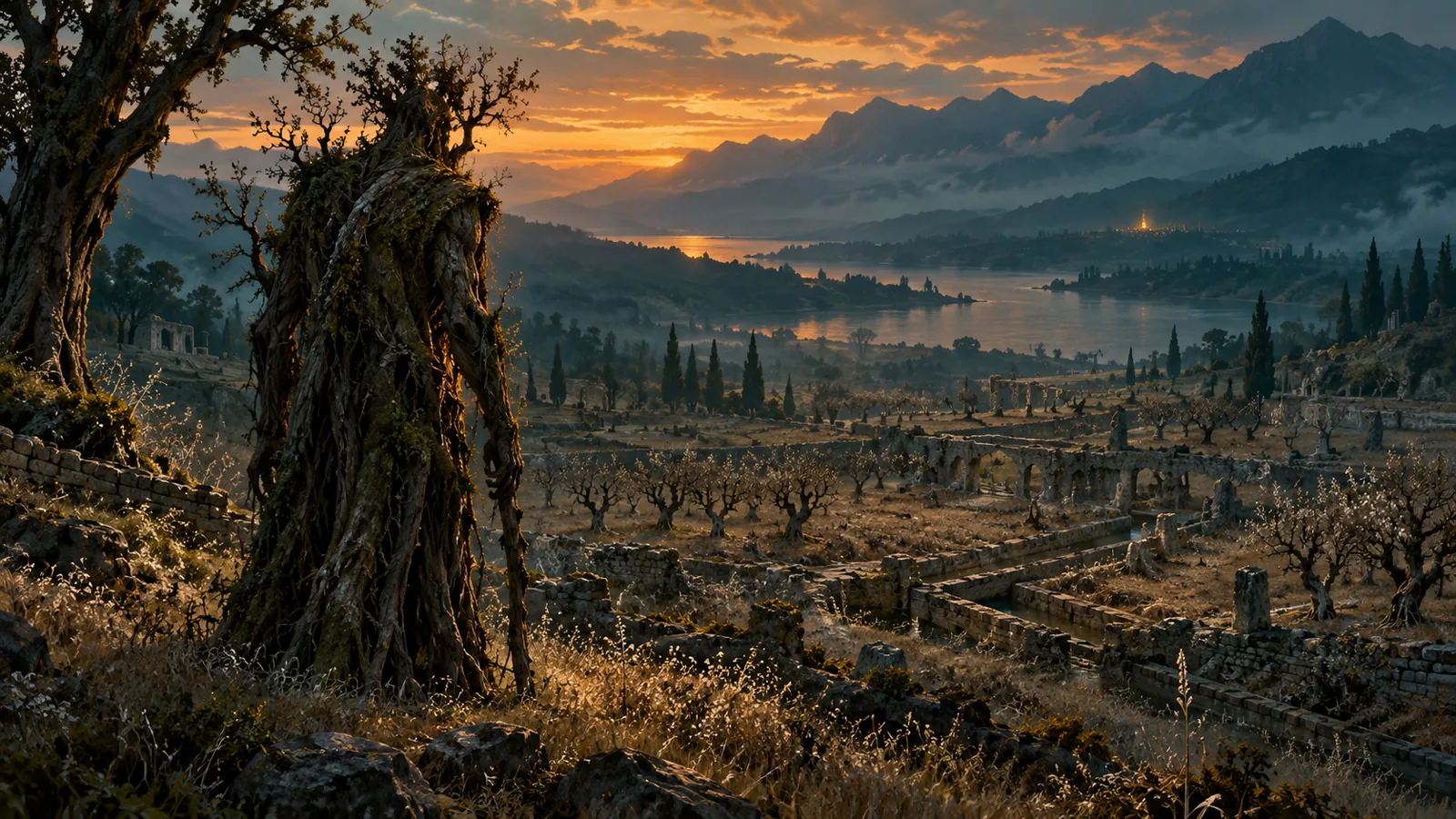
What happened to the Entwives? It is one of those questions Tolkien allows to rise naturally from the world and then refuses to settle. Treebeard can tell Merry and Pippin where the Entwives once lived, what they loved and how the Ents searched for them, but he cannot say where they went. The story gives us traces rather than an answer: ruined gardens, conflicting rumours, an old song and a curious tale from the Northfarthing.
The uncertainty is not a gap in the legendarium waiting for a clever theory to close it. It belongs to the meaning of the Ents themselves. They are among the oldest speaking peoples still walking in Middle-earth, yet age has not given them mastery over loss. Treebeard remembers ages that have vanished, names places no map now carries, and can summon a forest to war. He still does not know whether Fimbrethil, the Entwife he loved, remains somewhere beyond his sight.
That unhealed absence gives the Ents their deepest sadness.
Two ways of loving the earth
Treebeard explains that the Ents and Entwives did not begin as enemies, nor did they divide because one group cared for growing things and the other did not. Both loved the earth. They loved it differently.
The Ents delighted in the great trees and the freedom of the woods. They wandered, listened and learned the long speech of things that grow slowly. Their care was patient and spacious; they wanted the trees to become more fully themselves. The Entwives turned toward orchards, grain, vegetables, flowers and the smaller plants that answer cultivation. They valued order, abundance and peace, making gardens where many good things could flourish together.
It is tempting to turn this distinction into a simple moral argument—to praise the wild forest and distrust the ordered field—but Tolkien does not make it so easy. The Entwives’ work is fruitful. They teach Men the arts of agriculture and are honoured for it. Their gardens are not an industrial wound in the earth; they are another kind of relationship with it, shaped by tending, seasons and harvest.
Yet the difference matters. The Ents visit the gardens and wish the Entwives would return to the forests. The Entwives believe the lands they have made are better suited to them. Affection remains, but shared life becomes occasional, and then distance begins to do what distance does: habits divide, visits become rarer, and two ways of loving the same world cease to inhabit one home.
Tolkien does not tell us that either love was false. He shows us how good loves can drift apart when each becomes unable to dwell within the other’s vision.
The gardens east of Anduin
The Entwives eventually cross the Anduin and establish their gardens in the lands that will later be called the Brown Lands. From there, their influence extends beyond their own people. Men learn from them, and the ordered richness of their country becomes a quiet centre of cultivation east of the river.
Almost none of this world is visible by the time the Fellowship passes nearby. Tolkien lets us know it chiefly through contrast. The Brown Lands are bare and desolate, a stretch of withered country where the living memory of gardens survives only in Treebeard’s account. What was once tended has not merely been abandoned; it has been violently unmade.
This is one reason the Entwives matter even though they never appear. Their absence turns landscape into testimony. The land remembers what the narrative cannot show us directly. Dry earth, broken growth and emptiness become the negative shape of a lost people.
Middle-earth is full of such places. Weathertop retains the shadow of an ancient watchtower; Moria holds the labour and catastrophe of the Dwarves; the ruins of Osgiliath speak of a kingdom divided. The Brown Lands are quieter, but their grief is no less real. A garden is a promise made over time: that someone will return to water, prune, sow and gather. When war destroys a garden, it attacks not only what is growing now but the expectation of return.
How the Brown Lands were made
During the war of the Last Alliance, the country of the Entwives was burned and devastated as Sauron sought to hinder his enemies. Tolkien’s later explanation in Letter 144 presents grim possibilities. The Entwives may have been destroyed with their gardens; some may have escaped eastward; some survivors may even have fallen under Sauron’s domination and become estranged from the Ents they had left behind.
None of these possibilities is confirmed. All of them reveal the character of the Enemy. Sauron’s evil is not limited to armies and towers. It is the will to reduce living variety to usefulness, obedience or ash. The Entwives cultivate because they desire fruitfulness; Sauron destroys because he cannot permit any order he does not control.
The burning of their land also deepens Tolkien’s account of war. Victory over Sauron at the end of the Second Age is real and necessary, but victory does not restore everything consumed along the road. The Last Alliance overthrows the Dark Lord for a time. It does not bring the Entwives home.
That is a truth Tolkien understood with unusual clarity. A just victory may prevent a greater ruin while leaving losses no triumph can reverse. History moves forward, songs are written and kingdoms are renewed, yet somewhere an old creature continues searching through the aftermath for a voice that never answers.
The cost of a people divided
The disappearance of the Entwives is not only Treebeard’s private grief. Without them there are no Entings, and without Entings the Ents have no future beyond the endurance of those who remain. Some die; others grow increasingly tree-like; the shepherds of the forest become fewer as the ages pass.
This makes the march on Isengard more poignant. The Ents rise with enormous power, break Saruman’s machinery and release the waters that cleanse his works, but their awakening does not reverse their own decline. They can still change the course of the War of the Ring. They cannot command the return of what would allow their people to begin again.
Treebeard therefore stands at the meeting point of strength and helplessness. He can wrench stone apart, but he cannot find Fimbrethil. He can remember the Entwives as they were in youth and as labour changed them, but memory cannot cross the distance that history has placed between them.
His refusal to say that they died is not denial. He is precise: they were lost, and the Ents cannot find them. Hope remains because knowledge is incomplete. Sorrow remains for exactly the same reason.
The Shire and the walking tree
Tolkien plants two details that have kept readers wondering. Early in The Fellowship of the Ring, Sam speaks in the Green Dragon of a story told by his cousin Halfast Gamgee, who claimed to have seen a tree-like giant walking beyond the North Moors. Ted Sandyman laughs it away. Much later, when Merry and Pippin part from Treebeard, they promise to watch for the Entwives, and Treebeard reflects that they would have liked the Shire.
The connection is irresistible. The Shire is cultivated without being consumed by cultivation: hedges, fields, kitchen gardens, orchards and old trees held together within an ordinary pattern of care. If any surviving Entwives had wandered west, it seems like a country they might recognise.
But a possibility is not a revelation. The walking tree may have been an Ent, an Entwife, another creature or only a fireside story enlarged in the telling. Treebeard’s affection for the Shire tells us what sort of land the Entwives loved; it does not prove they reached it.
Tolkien’s restraint protects the mystery. If the clue solved everything, Treebeard’s long loss would collapse into a missed appointment on a map. Instead, the Shire becomes a place of imaginative hope—a reminder that somewhere beyond the borders of our knowledge, the lost may have found shelter.
The song that looks beyond the story
The old song of the Ent and the Entwife imagines their different landscapes and their longing for one another. Its final movement does not offer a route or date for reunion. It looks beyond the present world toward a country in which both may be content, a place spacious enough to reconcile forest and garden.
This is not evidence that the Entwives survived, and Tolkien did not offer easy optimism in his letters. The song does something subtler. It gives longing a form that neither pretends the separation is small nor treats separation as the last truth that can ever be spoken.
That pattern runs throughout Middle-earth. Hope often arrives without possession. Characters act without knowing the end, preserve what they can without assurance that it will endure, and trust that no faithful love is meaningless even when its fulfilment lies beyond the borders of the tale.
The Ents continue to remember. Their song keeps relationship alive where certainty has failed.
Why Tolkien leaves the question open
A lesser story might return the Entwives after Isengard falls, rewarding Treebeard’s courage with the restoration he most desires. Tolkien refuses that tidy exchange. Good deeds are worth doing because they are good, not because providence guarantees the particular ending we would choose.
Treebeard helps save Rohan and contributes to the defeat of Saruman. He does not receive Fimbrethil as payment. His faithfulness remains real, and his grief remains real beside it.
Perhaps this is why the mystery stays with us. Most lives contain questions that cannot be solved by gathering one more fact. There are friendships that changed without a final conversation, homes whose former life can be remembered but not recovered, and people whose paths moved beyond our reach. We may refuse to call them meaningless, yet we cannot write the missing ending ourselves.
Tolkien allows Treebeard that honest middle ground. He does not know. He still remembers. He still hopes.
The Entwives may be gone beyond recovery within Middle-earth, or some may have survived in lands no chronicler entered. The story does not ask us to choose certainty where none was given. It asks us to hear the weight of the absence, to notice the ruined garden and to understand that the fading of the Ents began not only with war, but with loves that could no longer find a common home.
And still the old song looks west.
Source note: This reflection draws principally on J.R.R. Tolkien’s The Two Towers, Book III, Chapter 4, “Treebeard”; The Fellowship of the Ring, Book I, Chapter 2, “The Shadow of the Past”; The Return of the King, Book VI, Chapter 6, “Many Partings”; and The Letters of J.R.R. Tolkien, Letter 144, dated 25 April 1954. Tolkien offered possibilities for the Entwives’ fate but did not settle it.