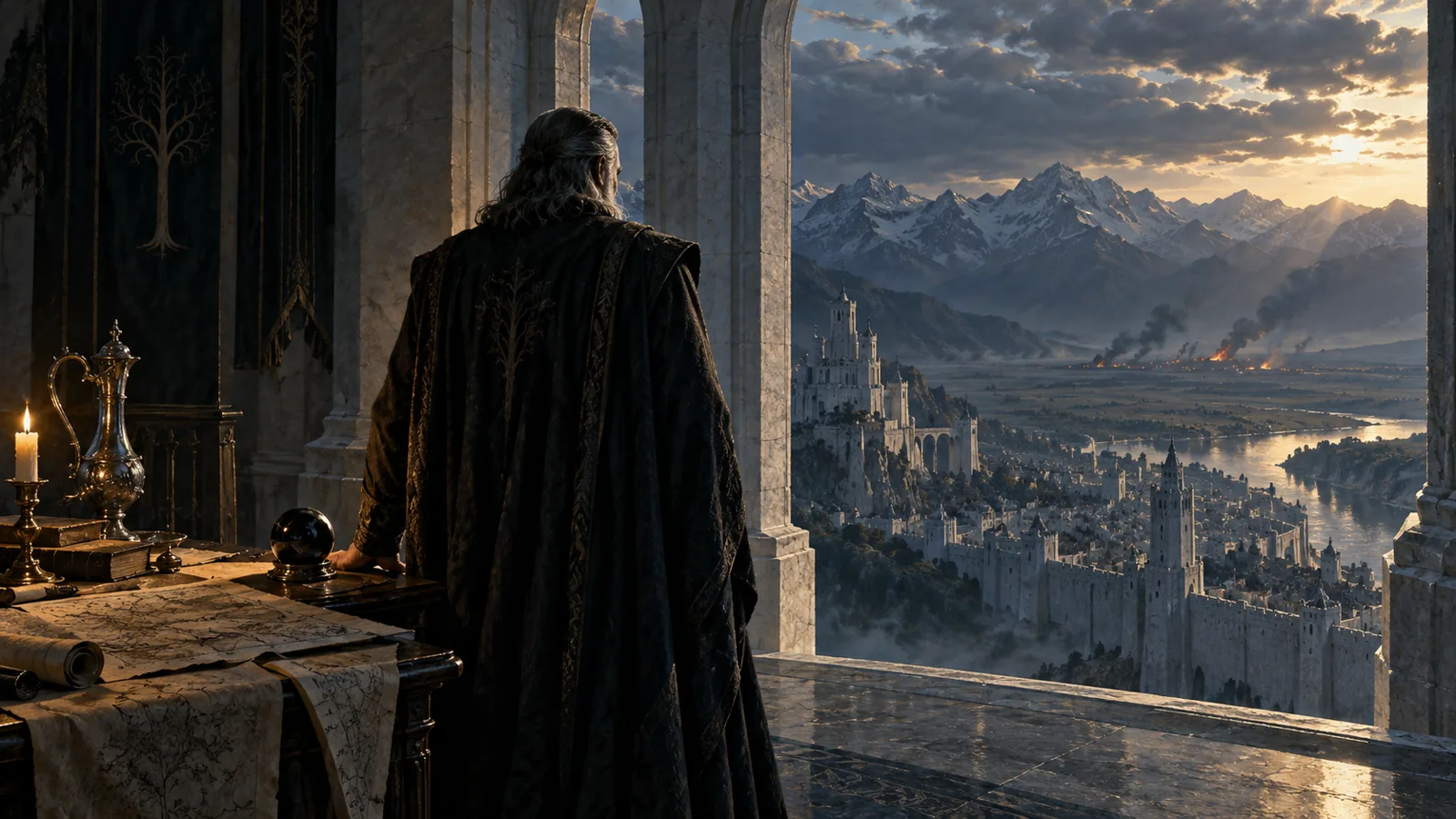
Denethor in The Lord of the Rings enters the story seated beneath an empty throne, holding a white rod of office while the darkness gathers beyond the walls of Minas Tirith. He is old, but not feeble; proud, but not foolish; worn by years of vigilance, yet still possessed of a formidable mind. Pippin, expecting perhaps a remote ceremonial ruler, discovers a man who misses little and forgets less.
This matters because Denethor’s tragedy is often made smaller than Tolkien wrote it. If he were merely a mad old man, his fall would tell us little. If he were only cruel, the final horror in the House of the Stewards would seem inevitable. But Denethor has courage, discipline and genuine devotion to Gondor. His despair is terrible precisely because it grows through virtues that have become isolated from trust, mercy and hope.
He sees much. He cannot bear that he does not see all.
The Steward before the shadow
For decades Denethor has governed a kingdom living beneath threat. Gondor’s strength has diminished, its northern realm has vanished, and Mordor is no distant rumour. Osgiliath lies ruined across the river; Ithilien has become contested ground; each generation inherits fewer resources and a heavier watch. To rule from Minas Tirith is to keep faith with the past while knowing that the next assault may be the one the city cannot withstand.
Tolkien’s Appendices describe Denethor as a man of great will and foresight, more kingly than many who had borne the title of Steward before him. He studies the Enemy, gathers knowledge and refuses to surrender his responsibility to comforting illusions. He is not asleep at his post. Gondor is prepared for war because its Steward has spent himself preparing it.
Yet vigilance has slowly hardened into solitude. After the early death of his wife, Finduilas, Denethor becomes grimmer and more silent. He loves his sons, but expresses that love through expectation and comparison; he trusts his own judgement, but increasingly receives counsel as a challenge to his authority. The office meant to preserve a kingdom begins to close around the man who bears it.
A burden carried faithfully can still become dangerous when the bearer believes that only he can carry it.
The temptation of seeing too much
Denethor’s secret use of the palantír is central to his decline. The Anor-stone is not a magical device that simply fills his mind with Sauron’s lies. As ruling Steward, Denethor has a lawful claim to use it, and his strength is such that Sauron cannot easily dominate him. The stone shows real things. That is what makes it perilous.
Through it, Denethor can look beyond the walls, measure armies and perceive movements hidden from ordinary sight. For a ruler charged with protecting the last great city in the West, such knowledge must seem almost impossible to refuse. Every glimpse promises an advantage. Every unanswered question invites another search.
But information is not wisdom, and sight is not understanding. Sauron cannot make the stone display a simple falsehood, yet he can direct attention, choose what is revealed and withhold the wider pattern. Denethor sees forces too vast for Gondor to defeat and, near the end, the black-sailed fleet drawing up the river. What he cannot see is Aragorn aboard those ships, bringing aid rather than destruction.
The images are true. The conclusion is false.
This is one of Tolkien’s sharpest accounts of despair. Denethor is not deceived because he knows nothing; he is deceived because he mistakes partial knowledge for the whole. He looks farther than almost anyone in Minas Tirith, but the very reach of his vision persuades him that nothing lies beyond it.
Knowledge without fellowship
There is another danger in the palantír: Denethor uses it alone. He does not bring what he has seen into fellowship where it might be questioned, enlarged or set beside another person’s hope. Knowledge becomes a private contest between his will and Sauron’s, and the Enemy is content to let that contest exhaust him.
Gandalf also understands the scale of the darkness, perhaps better than any mortal in Gondor, but he carries his knowledge differently. He moves among free peoples, receives the help of the small and unexpected, and leaves room for providence to work beyond calculation. His hope is not cheerfulness. It is the disciplined refusal to grant evil perfect knowledge of the future.
Aragorn, too, confronts Sauron through a seeing-stone. Yet he does so as the rightful heir, at a chosen moment, for a limited purpose, and then acts in company with others. Denethor’s long secret watching has a different shape. He seeks not one necessary truth but the certainty that will let him master every possibility. The more he sees, the less able he becomes to receive anything he did not foresee.
Hope requires a certain humility before the unfinished story. Denethor’s pride cannot endure that openness. If rescue cannot come by a road he understands, he decides that rescue cannot come.
A father divided by grief
The death of Boromir strikes the deepest fracture in Denethor’s heart. Boromir embodied the kind of strength he could readily honour: valour in battle, directness of purpose and fierce loyalty to the city. Faramir is no less brave, but his love of lore, his friendship with Gandalf and his suspicion of power resemble qualities Denethor has learned to distrust.
When Faramir reveals that he allowed Frodo to continue toward Mordor, Denethor cannot see moral courage. He sees the loss of a weapon and, through grief, wishes that his sons’ places had been exchanged. The cruelty of that moment does not mean he has ceased to love Faramir. It shows how badly grief can distort love when sorrow is turned into accusation.
Faramir is then sent back into a defence that can achieve little except delay. Denethor is not deliberately sending his son to die; the retreat must be covered, and Faramir accepts the duty. Yet the command bears all the weight of their wounded relationship. When Faramir is brought back gravely ill, Denethor’s remaining defences collapse. The ruler who could face armies cannot face the possibility that both sons have been taken from him.
Grief deserves compassion. It does not make every act born from grief innocent. Denethor’s sorrow becomes possessive: if he cannot preserve his son, he will determine the manner of their ending together.
When stewardship becomes possession
The word steward describes authority held in trust. Denethor’s office exists to guard Gondor until the return of the King, however remote that return may seem. He has served that trust with extraordinary endurance. But in the final hours, the distinction between guarding and possessing has almost disappeared.
He resents Aragorn not simply as a doubtful claimant but as a future he did not author. A restored king would mean that Denethor’s long labour had prepared a realm for someone else to receive. This is the hidden test within all stewardship: whether we can love a thing enough to serve it without needing it to remain ours.
Faramir passes that test when he refuses the Ring and later welcomes the King. Denethor cannot. His identity has become so bound to Gondor’s survival under his rule that he would rather choose the ending than live into a restoration that asks him to yield.
The contrast is not between a weak man and a strong one. It is between two kinds of strength. One grips more tightly as control is lost; the other remains faithful while accepting that the good may be completed by hands beyond its own.
The pyre and the refusal of hope
In Rath Dínen, Denethor commands that a pyre be prepared for himself and the still-living Faramir. Even here, Tolkien does not turn him into a spectacle. His fall retains a dreadful dignity. He breaks the white rod of stewardship, lays himself upon the table and reveals the palantír that has consumed his hope.
Gandalf’s intervention saves Faramir, but it cannot save Denethor against his will. That distinction is essential. Help arrives. The city has not fallen. The black ships do not carry enemies. The hands of a healer are nearer than Denethor knows. Yet despair has become more than a feeling: it is his final claim to possess the meaning of events. He chooses the certainty of ruin over the vulnerability of being proved wrong by hope.
Despair often presents itself as clear sight. It says that it has counted every army, read every sign and stripped away every comforting tale. Tolkien does not answer by denying the armies or pretending the signs are harmless. He answers by showing that no creature within the story can see its whole design.
There are true facts that do not contain the whole truth.
What Denethor helps us see
Few of us will govern a besieged city, but Denethor’s temptation is near at hand. We gather information in the hope that enough knowledge will deliver certainty. We carry responsibility until accepting help feels like failure. We protect a family, a calling or a community so fiercely that we forget it was entrusted to us, not given for our possession. Then, when grief enters, we read every unknown as proof that the worst must come.
Denethor warns us that intelligence cannot substitute for fellowship, and that realism severed from humility can become another form of illusion. The remedy is not ignorance. Gandalf pays close attention; Aragorn plans boldly; Faramir fulfils his duty. Their hope is sturdier because it does not require them to control the entire field.
To hope in Tolkien is to act faithfully within the portion of the story we can see, while refusing to declare that our portion is all there is. It is to receive counsel, allow grief to be shared, and leave room for providence without demanding that providence explain itself in advance.
Denethor’s end is one of the saddest in Middle-earth because he stands so close to deliverance and cannot imagine receiving it. His city survives. His son awakens. The King returns. Much of what he laboured to preserve is restored, though not by the path he expected.
The tragedy of the Steward is not that he cared too much for Gondor. It is that, at the last, he could no longer believe Gondor might be held by hands other than his own.
Source note: This reflection draws on J.R.R. Tolkien’s The Return of the King, Book V, especially “Minas Tirith”, “The Siege of Gondor” and “The Pyre of Denethor”; Appendix A, “The Stewards”; and Unfinished Tales, Part Four, “The Palantíri”. The palantíri communicate real images, but what a user sees can be selected, limited and dangerously misread.