After Mount Doom, the Field of Cormallen and the coronation of Aragorn, it would be easy to believe that the story has completed its proper movement. The central evil has fallen, the hidden king has entered his city, and the four hobbits may at last travel north towards the quiet country whose memory sustained them through darkness. Home waits at the end of the road.
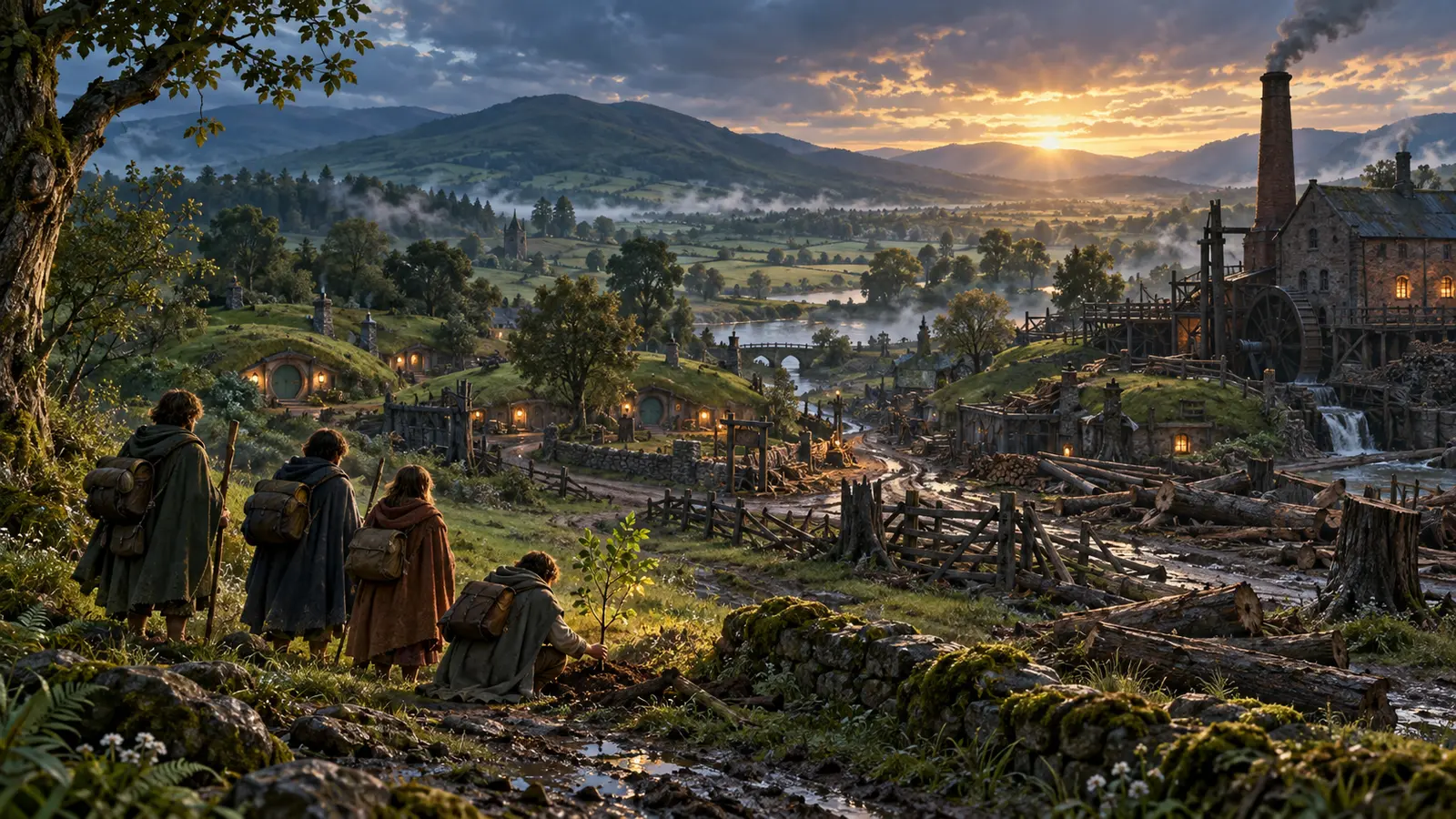
But the Shire they find is no longer the Shire they left. Gates block the way. Rules have multiplied. Shirriffs carry out orders they barely understand, food and goods have been seized, trees have been felled, and ugly structures have spread through fields that once seemed beyond the reach of the world’s great troubles. The language of improvement disguises waste, fear and control. Even Bag End has become the headquarters of a diminished tyrant.
The Scouring of the Shire can feel, on a first reading, like an unexpected second ending. In truth, it is where the meaning of the whole journey comes home.
The Shire was never outside history
The Shire begins as a place protected partly by innocence and partly by ignorance. Its inhabitants know little of the Rangers guarding their borders, the wars gathering in the East or the long memory of the kingdom whose laws still give shape to their land. That sheltered life is good, but it is not self-sustaining. Peace has been preserved by sacrifices the Shire does not see.
Frodo’s departure reveals this hidden dependence. He leaves so that home may remain untouched, carrying the Ring away from fields, kitchens and ordinary celebrations that have no idea how near danger has come. Yet Tolkien refuses the comforting thought that goodness can be permanently protected by distance. Saruman’s reach is smaller than Sauron’s, but it is sufficient to wound the Shire while its bravest defenders are away.
This does not make Frodo’s quest pointless. The Shire can be liberated precisely because the greater Shadow has been broken and the travellers have returned with courage, wisdom and friendships forged beyond its borders. Still, their homecoming corrects an illusion: no beloved place remains safe merely because it is small, familiar or undeserving of harm.
Saruman reduced, but not harmless
Saruman’s presence at Bag End is deliberately humiliating. He was once the head of the order of Wizards, a master of lore whose voice could bend the judgement of kings. At Isengard he dreamed of matching Sauron through engines, armies and calculated power. In the Shire, now known as Sharkey among his followers, his dominion has shrunk to confiscated stores, petty regulations, frightened officials and the pleasure of spoiling what others love.
Yet the smallness of his rule does not make it innocent. Tolkien understood that domination does not cease to be domination when its ambitions become provincial. Saruman brings the logic of Isengard into lanes and gardens: everything must be counted, gathered, ordered and made useful to the will at the centre, while living beauty is treated as an obstacle or a resource.
In his 1951 letter to Milton Waldman, Tolkien described the Machine not simply as technology, but as the desire to make the will effective through external force, replacing patient growth with coercion and control. The Shire’s new mill belongs to that moral landscape. The problem is not that a wheel turns or grain is ground. It is that making has been separated from service, scale from need and efficiency from love. The result produces smoke, noise and waste while the people it claims to organise become poorer.
Tolkien resisted a neat allegorical reading of the chapter. In the Foreword to the Second Edition, he explained that the Scouring had grown from the story’s own development rather than being added as a direct commentary on one contemporary political event. Its relevance is broader and more searching: whenever improvement becomes a name for possession, and order becomes an excuse for removing freedom, Saruman’s spirit has found another small country to manage.
The four hobbits return as different people
The travellers who cross the Brandywine are not the hobbits who once left in secrecy. Merry has ridden with the Rohirrim and learned how courage can rally a people without despising them. Pippin has served the Steward of Gondor and stood before the Black Gate. Sam has carried Frodo when strength failed, while Frodo has passed through suffering so deep that power itself has lost its glamour.
Each now brings home a different gift. Merry understands defence and organises resistance. Pippin summons the Tooks and carries himself with the confidence of a knight. Sam moves naturally towards neighbours, practical work and the future life of the land. Frodo, who no longer desires command, insists that liberation must not become an excuse for vengeance.
Gandalf does not ride in to settle the matter for them. His absence is essential. The great guide has brought them far enough that they can use their own judgement, courage and mercy. The Shire will not be saved by importing a stronger wizard to defeat the weaker one; it will be saved when ordinary people refuse fear, recover responsibility and stand together.
This is the proof of their journey. They have not become great by ceasing to be hobbits. They have become more fully themselves.
The Battle of Bywater and the limits of victory
The resistance culminates in the Battle of Bywater on 3 November 3019, the final military engagement of the War of the Ring. Merry and Pippin help shape a disciplined defence against the ruffians, but the purpose is liberation rather than slaughter. Frodo urges the hobbits to avoid killing where they can and to protect enemies who surrender.
His restraint can appear almost passive beside the energy of the others, yet it is one of the strongest expressions of his character. Frodo has seen what the wish to master evil by greater force can become. He will defend the Shire, but he will not allow hatred to decide what the restored Shire is for.
That conviction is tested when the travellers reach Bag End and discover Saruman. The fallen Wizard attempts one final act of violence, but Frodo still refuses revenge and offers him the possibility of leaving alive. Saruman cannot receive mercy without feeling judged by it, because mercy reveals how completely his own vision has narrowed. He departs in bitterness, only to die through the violence he has cultivated in Gríma.
The scene offers no easy satisfaction. Saruman’s end is miserable, Gríma’s is needless, and Frodo cannot rejoice in either. Evil has been defeated, but violence still leaves a stain on the ground where home ought to begin again.
Restoration is not a return to yesterday
Once the ruffians are gone, the deeper work begins. Buildings can be repaired and stores returned, but the Shire cannot simply be placed back inside the untouched memory the travellers carried. The Party Tree is down. Familiar views have been altered. People have been frightened, compromised or bereaved. Frodo himself has returned, but part of him will never come home.
Sam becomes the central figure in the restoration because his answer to destruction is cultivation. He plants saplings wherever beloved trees have been lost, sharing the soil Galadriel gave him rather than hoarding its blessing for his own garden. Where the Party Tree stood, he plants the silver nut from Lórien, and a mallorn rises in the Shire—something new, born from grief, generosity and a friendship between distant lands.
The Golden Tree does not replace the old tree by pretending nothing happened. It remembers the wound and answers it with new life. The Shire that emerges is not identical to the one before the war; it is more beautiful in some ways, more sorrowful in others, and conscious at last that peace must be tended.
This distinguishes restoration from nostalgia. Nostalgia wants the past returned untouched. Restoration receives what remains, mourns what cannot be recovered and begins the patient work by which a wounded place may become fruitful again.
Why Tolkien needed this ending
Without the Scouring, the hobbits would return as honoured witnesses to great events elsewhere. With it, every lesson of the quest becomes a responsibility. Courage must organise neighbours. Fellowship must cross old divisions. Mercy must govern victory. The gifts of Lórien must enter common soil. Even kingship matters through the freedom and protection it restores to people far from the throne.
The chapter also refuses a familiar fantasy: that defeating one great enemy will remove the need for ordinary faithfulness. Sauron falls in a single terrible moment, but healing happens through meetings, rebuilding, planting, sharing and the slow recovery of trust. The great victory creates the possibility of renewal; it does not perform renewal on anyone’s behalf.
That is why this late chapter speaks so clearly beyond Middle-earth. We may long for one decisive event that will set everything right—a solved crisis, a changed government, a healed relationship, a finished struggle. Sometimes such moments come, and they matter. Yet afterwards we still have to return home and ask what love requires here, among the fields we know and the people whose names we carry.
The final heroism of the Shire is not conquest. It is stewardship.
The road ends in a garden
The War of the Ring ends not only with a crown or a ruined tower, but with hobbits setting their own country in order and a gardener kneeling in damaged earth. Merry and Pippin bring courage home. Frodo brings mercy. Sam brings the future.
Tolkien does not promise that every wound can be undone. Frodo’s departure remains ahead, and the old Party Tree will not rise again. But providence works through what has been carried back: hard-won wisdom, unexpected friendship, a box of earth and the willingness to plant where others have cut down.
The Scouring of the Shire matters because it tells us what victory is for. The world is not saved so that heroes may remain forever in songs. It is saved so that homes can be tended, neighbours can live freely, trees can grow, and ordinary goodness can begin again.
Source note: This deep dive draws principally on J.R.R. Tolkien’s The Lord of the Rings: The Return of the King, Book VI, Chapters 8–9 (“The Scouring of the Shire” and “The Grey Havens”), and the Foreword to the Second Edition. The discussion of the Machine also draws on Tolkien’s 1951 letter to Milton Waldman, published by the Tolkien Estate. No lengthy text is reproduced.