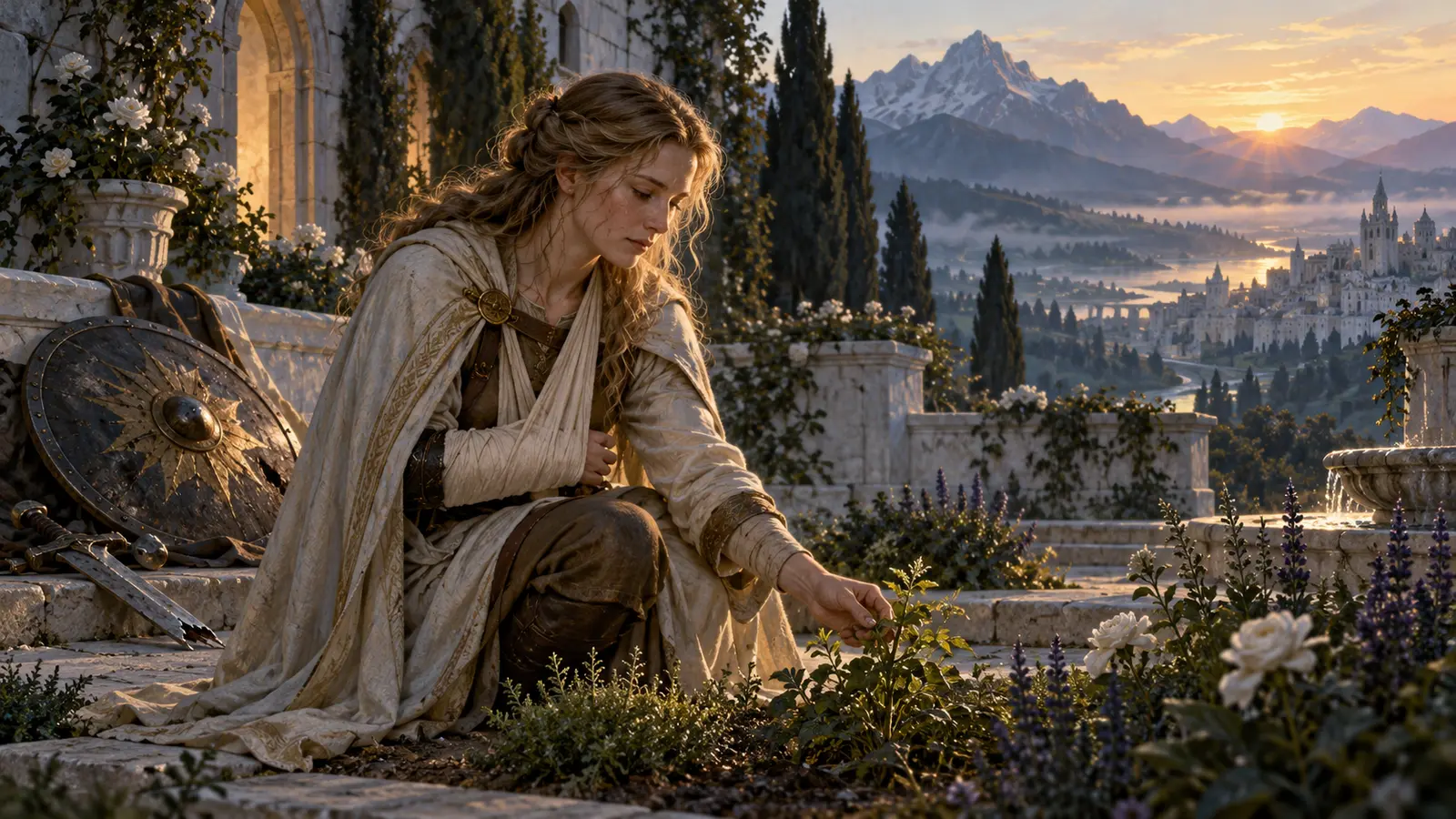
When we remember Éowyn, we often see her on the Pelennor Fields: standing before a terror that has broken armies, casting aside the disguise of Dernhelm and refusing to abandon Théoden’s body. It is right that this moment endures. She and Merry accomplish what no great warrior could have managed alone, and the Lord of the Nazgûl falls through courage the proud had overlooked.
Yet Tolkien does not leave Éowyn there. He carries her from the battlefield into the Houses of Healing, where the broken arm can be bound but the deeper shadow does not lift at once. The woman who faced the Witch-king still has to learn how to face a future. Her most famous victory saves others from death; her quieter victory is to begin wanting life for herself.
That second courage is less dramatic, but it may be nearer to many of us.
The cage before the battlefield
Éowyn’s despair does not begin in Gondor. Long before she rides to war, she has lived in the dimness of Meduseld while Théoden declines under Gríma’s influence. She serves her uncle faithfully, watching strength, counsel and hope slowly drain from the hall, while her brother rides freely with the Rohirrim and the wider world appears to move beyond her reach.
Her complaint is not that care is beneath her. Tolkien gives no reason to doubt the love with which she attends Théoden. The wound lies in being confined to a role others have defined for her, with no visible end and little recognition of the cost. Gríma’s attention makes the hall still more oppressive. The home she protects has become a place in which she cannot imagine becoming fully herself.
When Aragorn arrives, Éowyn sees not only a great man but a road out of enclosure: action, honour and a life whose meaning can be proved before witnesses. His refusal does not create her despair, though it sharpens it. The despair was already there, shaped by years of helplessness and by the fear that all her strength would be spent waiting beside a failing king while others won renown.
Many lives contain gentler versions of that cage. Responsibility narrows the horizon; illness or grief makes every week resemble the one before; work that once felt loving begins to feel invisible. We may continue faithfully while quietly believing that our own life has been postponed. The danger is not only exhaustion. It is that escape can begin to look more desirable than healing.
When glory becomes another form of escape
Éowyn wants to do deeds worthy of song, and that desire is not false. Rohan truly needs courage, and she possesses it. But by the time she takes the name Dernhelm and rides with Merry, courage has become entangled with a wish not to return. She seeks a great deed partly because an honourable death seems better than the life she believes awaits her.
This complexity does not diminish what she does on the Pelennor. When Théoden falls and the Witch-king descends, Éowyn does not act for applause. She stands between evil and someone she loves. Merry’s hidden stroke makes the enemy vulnerable, and Éowyn uses the opening at terrible cost. Their victory is genuine because their courage is genuine.
But victory cannot heal a wound it did not make. The Witch-king is destroyed; the despair that rode with Éowyn is not. Tolkien understands that one heroic moment does not untangle every reason a person entered it. We can do something brave while carrying pain that remains after the danger has passed.
This is why achievement sometimes leaves an unexpected emptiness. We imagine that completing the work, surviving the crisis or proving our strength will answer everything that drove us toward it. Then the noise fades, and the older questions are waiting. What do I live for when there is no enemy before me? Who am I when endurance is no longer the only task?
A wound that victory cannot heal
Aragorn calls Éowyn back from the Black Shadow in the Houses of Healing, just as he helps Faramir and Merry, yet bodily recovery is only the beginning. She rises, demands freedom and asks to ride east with the captains. Her arm is injured, but the deeper obstacle is not weakness. She still imagines worth through battle and peace as a return to confinement.
Tolkien does not shame her for this. The Warden gives her time, air and a garden; no one argues her out of sorrow in a single conversation. Healing is shown as a process in which safety comes before interpretation, and strength may return before desire does.
There is wisdom here for the aftermath of grief, illness and prolonged responsibility. Relief does not always feel joyful when it first arrives. The body may leave danger while the mind remains organised around it. We can be told that the worst has passed and still not know how to inhabit the life that remains.
Healing cannot be commanded as another duty. It needs room.
The patience of being seen
Faramir meets Éowyn in that uncertain space. He, too, has come near death; he, too, carries wounds formed by duty, family and war. He does not approach her as a conqueror who will rescue a sad woman from herself. He notices her unrest, speaks truthfully and allows affection to grow without requiring her to become cheerful for his comfort.
Most importantly, he sees that the image Éowyn has pursued is not the whole of her. Her love for Aragorn has been bound to what he represents: escape, greatness and a heroic end. Faramir does not mock that longing, but neither does he flatter it. His presence helps create a place in which she can distinguish the life she truly desires from the death she had taught herself to call glory.
Good companionship often works in this unhurried way. It cannot choose life on another person’s behalf. It can listen without turning sorrow into a spectacle, offer truth without humiliation and remain near while an exhausted heart learns that it is not a burden.
Faramir does not give Éowyn a new identity. He helps her discover that she is free to choose one.
“I will be a healer”
When the Shadow passes and hope returns, Éowyn says, “I will be a healer, and love all things that grow and are not barren.” It is one of the most beautiful turns in The Lord of the Rings, and also one of the easiest to misunderstand.
Her choice is not a punishment for leaving the domestic place assigned to her, nor a claim that women should exchange courage for gentleness. Éowyn has already proved that she is a warrior, and no later vocation can erase the Witch-king’s fall. What changes is not her strength but the purpose toward which she gives it.
For years she has measured freedom by departure, greatness by renown and courage by readiness to die. Now she chooses work that requires her to remain: to cultivate, protect and help life become fruitful. Healing is not passive. It asks patience with what cannot be hurried, faithfulness when no song is written, and hope that invests in a future one may not control.
Nor is her decision a rejection of the sword in every circumstance. Middle-earth still needed the shieldmaiden who stood before the Nazgûl. The point is that battle will no longer decide the entire meaning of her life. She is not reduced when she turns toward growing things. She becomes more fully free.
The courage to desire life again
Some seasons train us to survive so thoroughly that survival becomes our only language. We learn to work through pain, prepare for bad news, keep watch and expect very little from tomorrow. These skills may carry us through the darkness, but they cannot by themselves teach us how to live when dawn arrives.
Choosing life again may begin quietly: accepting rest without treating it as failure, allowing another person to help, returning to a neglected garden, imagining work that is not built around proving our worth. It does not mean pretending the wound never happened or becoming grateful for what harmed us. Éowyn’s broken shield remains part of her story. It simply ceases to be the only object through which she understands herself.
Her future with Faramir in Ithilien is therefore more than a romantic reward. Together they enter a land scarred by the Enemy and take part in its renewal. Their love is turned outward toward a place that must grow again. After years in which both were valued chiefly for what they could endure, they are given the long labour of fruitfulness.
Providence does not undo Éowyn’s confinement, the darkness of the Nazgûl or the death of Théoden. It brings her through them without allowing them to possess the last word. The courage that carried her into battle becomes the courage to receive love, tend what is living and believe that peace can contain a calling of its own.
The shieldmaiden is not forgotten.
She lays down the broken sword because her hands have found something else worth holding.
Source note: This reflection draws on J.R.R. Tolkien’s The Two Towers, Book III, Chapter 6, “The King of the Golden Hall”; and The Return of the King, Book V, especially “The Passing of the Grey Company”, “The Muster of Rohan”, “The Battle of the Pelennor Fields” and “The Houses of Healing”, together with Book VI, Chapter 5, “The Steward and the King”. The single short quotation is spoken by Éowyn in that final chapter.