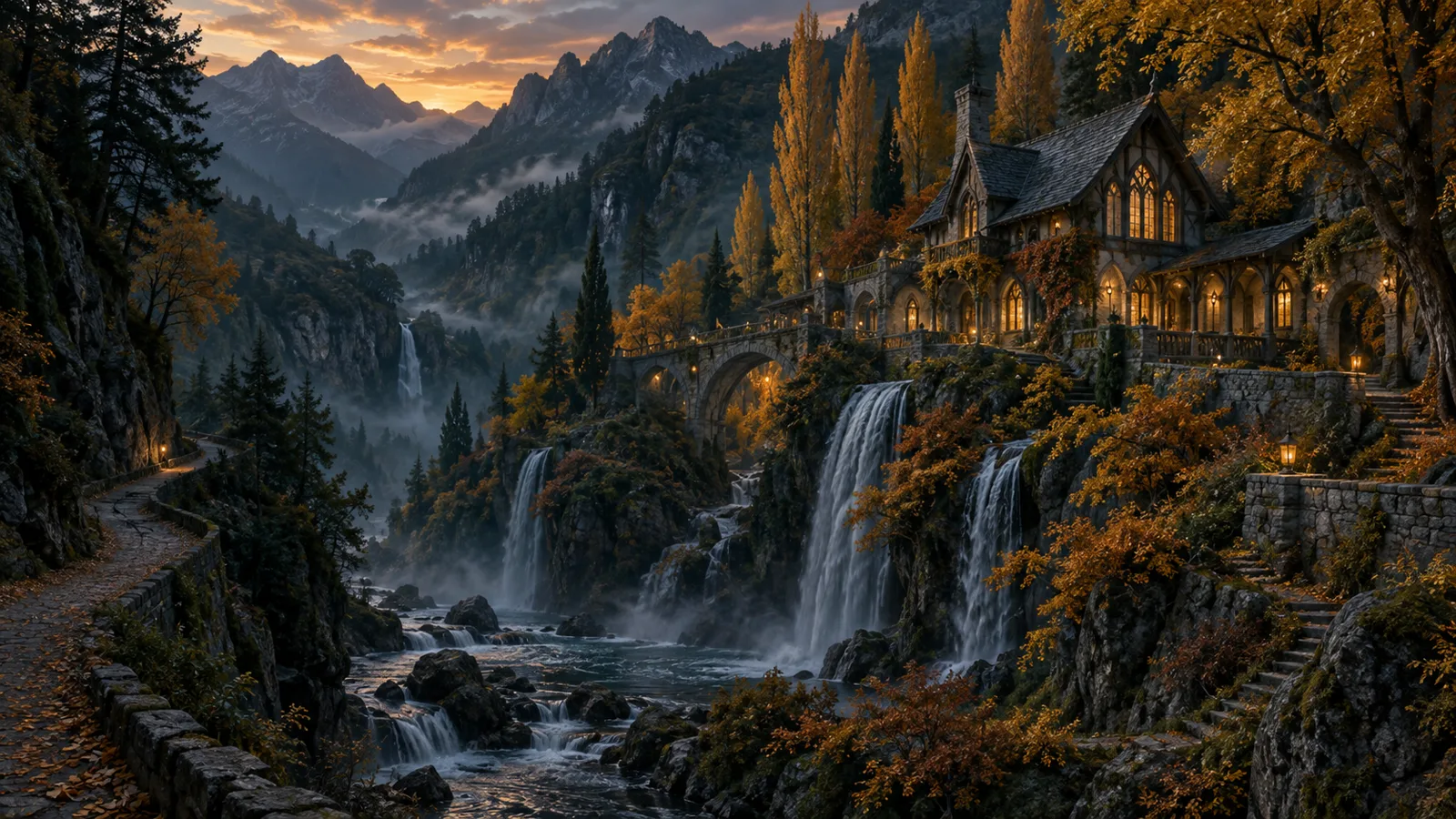
Rivendell in Middle-earth is first encountered as an answer to weariness. Bilbo reaches it after trolls, hunger and rain; Frodo arrives wounded by the Morgul-knife and pursued almost to its borders; later, travellers return there carrying griefs that cannot be solved by a night’s sleep or a well-laid table. The valley is hidden, but it is not sealed away from suffering. People come because the world has already hurt them.
That distinction matters. Rivendell is not an untouched paradise, nor is it a retreat built by those who have refused the burdens of Middle-earth. It is a place of healing founded in the aftermath of catastrophe, guarded by one who has inherited the long sorrow of both Elves and Men, and sustained for an age so that memory, wisdom and hospitality may remain available to those who still have roads to walk.
This is why the Last Homely House feels larger than its walls. It gathers what the world is in danger of losing, but it does not gather those things merely to possess them. Rivendell preserves the past in order to serve the future.
A refuge born from defeat
Rivendell was founded by Elrond in the Second Age, during Sauron’s war against the Elves of Eregion. It began not as an ornamental haven but as a refuge under pressure, a place made necessary by destruction. The smiths of Eregion had been deceived; their land was overrun; Celebrimbor was slain; and Elrond, sent with aid from Lindon, was forced back into the valley that would become Imladris.
The beauty we later encounter therefore has ruin beneath it. Its songs do not arise from innocence but from remembrance, and its peace has been patiently made by people who know what it costs when peace fails. Tolkien often gives his loveliest places this depth. They are not beautiful because sorrow has never crossed their boundaries; they are beautiful because sorrow has been received, named and woven into a form of life that does not surrender to it.
Elrond is the right guardian for such a place. Through his ancestry, the histories of Elves and Men, of Beleriand and Númenor, of loss and survival, meet within one life. His brother Elros chose the mortal path and became the first king of Númenor, while Elrond chose to be counted among the Elves. By the end of the Third Age, he has watched kingdoms rise and fail, sheltered the heirs of a broken line, and carried memories that for others have become little more than legend.
Rivendell is thus more than Elrond’s dwelling. It is the outward form of his stewardship: a place where what has survived is neither forgotten nor worshipped, but kept in trust.
The house where memory remains useful
There are several ways to preserve the past. One is to turn it into a museum, carefully protected and increasingly distant from ordinary life. Another is to use it as a weapon, insisting that inherited suffering gives the present generation permission to repeat old hatreds. Rivendell does neither.
Its memory remains hospitable. Bilbo can sit among ancient Elves and work on his book; songs from elder days can be heard by hobbits who know almost nothing of the histories behind them; broken swords, forgotten lineages and old promises are brought into the light, not to trap people within what has been, but to help them understand what must now be done.
Aragorn’s life shows this clearly. As a child he is fostered in Rivendell, where his identity is concealed for his protection. When the truth of his ancestry is finally revealed, it is not presented as a decoration or a guarantee. He has inherited a claim, but also a task. The memory of Isildur can become either a burden of repetition or a summons to faithfulness, and Rivendell gives Aragorn the knowledge he needs without pretending that ancestry can make his choices for him.
Bilbo, too, finds in Rivendell a place where memory can become gift. He does not simply retire into nostalgia. He translates, composes and records. The small traveller who once arrived bewildered becomes one of the people through whom stories are handed on. His presence quietly connects the domestic world of the Shire with histories far older than the Shire can imagine.
Memory in Rivendell is alive because it is shared.
Counsel without domination
Rivendell’s most important public moment is the Council of Elrond, yet even here Tolkien resists the image of a ruler gathering the world to issue commands. Representatives of different peoples arrive by separate roads, bearing separate troubles, only to discover that their stories belong to the same crisis. The Council is less a display of central power than an act of careful listening.
Elrond contributes knowledge, authority and judgement, but he does not seize the Ring, appoint himself its master or force another person to bear it. Voices are heard. Histories are compared. Tempting solutions are tested and rejected. The final path emerges slowly, through truth spoken in company.
This makes Rivendell a striking contrast to the forms of power gathering elsewhere. Sauron reduces every will to his own. Saruman’s counsel has become manipulation. Denethor increasingly isolates himself within knowledge that cannot be questioned. Elrond, by contrast, creates a place in which wisdom can be offered without becoming possession.
The distinction is central to Tolkien’s moral imagination. Good authority does not make every decision for others; it helps them see clearly enough to make faithful decisions themselves. Frodo’s choice is only meaningful because it is not extracted from him. The Fellowship is formed through consent, affection, duty and providence, not compulsion.
Rivendell protects freedom by making room for counsel.
The hidden cost of keeping beauty
Yet the valley’s preservation is not effortless. Elrond bears Vilya, one of the Three Rings of the Elves, and its power is associated with the protection and endurance of his realm. Like Lothlórien, Rivendell gives us a glimpse of what the Elves can keep from change: beauty held against weariness, memory sheltered against decay, a fragment of an older world lingering within a diminished age.
There is goodness in this keeping. Without it, much would have been lost before the right hour. Frodo might not have been healed; the shards of Narsil might not have been preserved; the heirs of Isildur might have vanished; the knowledge brought to the Council might never have found a common home.
But preservation cannot become permanent victory. The Three Rings are bound to the fate of the One, even though Sauron never touched them. When the One Ring is destroyed, their power also passes. The very act that frees Middle-earth from domination brings the long work of the Elves towards its end.
This is one of the most painful patterns in The Lord of the Rings: the right victory does not preserve every good thing exactly as it was. Some beauties belong to an age whose completion cannot be postponed without also postponing freedom. To demand that Rivendell remain unchanged would be to ask history never to move beyond the conditions that made Rivendell necessary.
Why the Last Homely House must fade
The word “last” has always been present in Rivendell’s welcome. The Last Homely House is a place of rest, but also a threshold. Westward lie memory, the Sea and the departure of the Elves; eastward lie the wild road, danger and the unfinished business of the world. Guests are restored there so that they may leave again.
That rhythm reveals the purpose of sanctuary. A true refuge does not make the road unnecessary. It gives the wounded enough strength to return to it, the confused enough wisdom to choose it, and the lonely enough fellowship not to walk it alone.
At the end of the Third Age, Elrond must finally take his own road west. His departure is not a confession that Rivendell failed. It is the completion of what Rivendell was for. The valley kept memory until memory could be handed on; it guarded hope until hope could take visible form in the defeat of Sauron and the return of the King. Its work was never to prevent the Fourth Age, but to help make a good Fourth Age possible.
There is a quiet wisdom here for anyone who has loved a home, a community or a season of life that could not remain. We often measure goodness by duration, as though something that ends must have failed to become what it should have been. Tolkien offers a gentler measure. Some places fulfil their purpose precisely by sheltering us for a while, giving us what we need and then releasing us into a future they will not share in the same form.
Rivendell is beautiful because it keeps. It is holy, in the deepest sense, because it also lets go.
A home that teaches us to depart
When we first encounter Rivendell, it seems like the destination every weary traveller would choose: food, firelight, music, wise company and the safety of a hidden valley. But Tolkien never allows comfort to become the final good. Bilbo must leave it to find the Mountain and return changed. Frodo must leave it while still carrying a wound. Aragorn must leave the house that fostered him and enter the kingdom he has been prepared to serve. Even Elrond must pass beyond its borders at last.
The Last Homely House therefore holds together two gifts we often separate: belonging and sending. It says that the road is not all there is, because there are places where we may be known, healed and welcomed without earning our place. It also says that refuge is not the same as escape, because love eventually asks us to carry what we have received back into the world.
Rivendell does not defeat time by refusing change. It redeems time through faithful stewardship, keeping alive what must not yet be lost and surrendering what cannot rightly be possessed forever.
And perhaps that is why we continue to long for it. Not because it promises that nothing beautiful will end, but because it shows that beauty can prepare us to meet an ending without despair.
Source note: This reflection draws principally on J.R.R. Tolkien’s The Silmarillion, “Of the Rings of Power and the Third Age”; The Lord of the Rings: The Fellowship of the Ring, Book II, especially “Many Meetings”, “The Council of Elrond” and “The Ring Goes South”; and the Appendices to The Lord of the Rings. Rivendell was established by Elrond in Second Age 1697 as a refuge during Sauron’s war against Eregion.