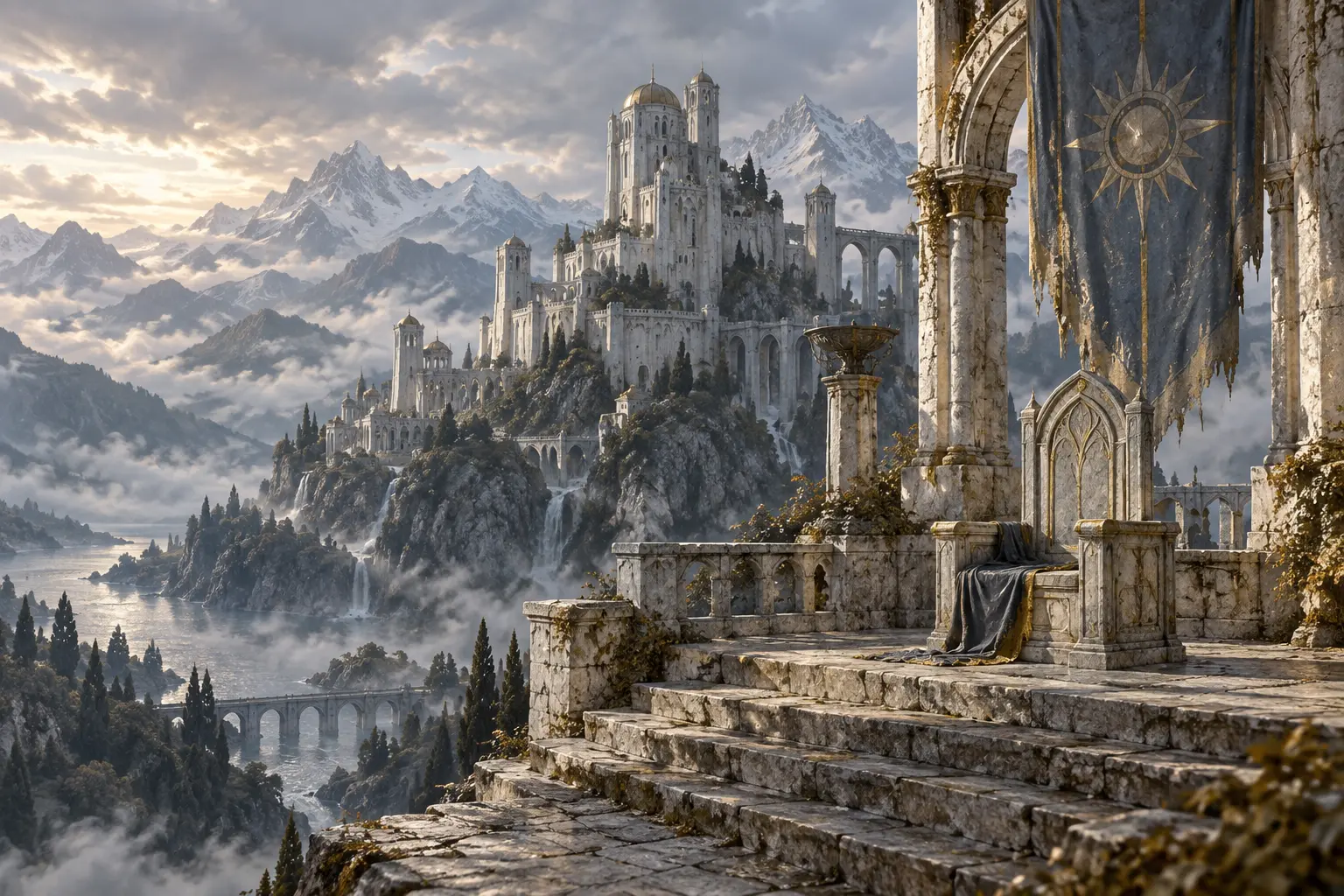
Gondor is a kingdom built as much from memory as from stone. Its towers, tombs and ceremonies preserve the shape of a greatness that is no longer fully present. The Númenórean past gives Gondor dignity, but it also places a heavy burden upon those born into its long decline.
By the time we enter Minas Tirith with Pippin, the city is still beautiful and formidable. Yet much of it feels empty. Houses stand without inhabitants. The White Tree is dead. The ruling house has vanished, and the Stewards govern in the name of a king whose return has become almost impossible to imagine.
The gift and danger of inheritance
Memory gives Gondor strength. Its people know that they belong to a story older than their present fear. They maintain walls, rituals and watchfulness because generations before them accepted the same responsibility. Their courage is not improvised at the last moment; it has been formed by inherited duty.
But inheritance can also become a prison. When the past is treated only as a lost height, the present begins to appear inadequate before it. Denethor knows more of Gondor’s history than almost anyone, yet his knowledge feeds despair. He measures what remains against what has been lost and concludes that decline must end in ruin.
Faramir carries the same memory differently. He does not despise the greatness of Númenor, but neither does he confuse greatness with domination. He can value learning, beauty and restraint while recognizing the worth of peoples beyond Gondor’s borders. For him, memory becomes a guide rather than an idol.
The meaning of stewardship
The Stewards hold authority that is real but deliberately incomplete. Their office is built around the recognition that the kingdom does not belong to them. They are guardians of something received, entrusted with preserving it for a future they may never see.
That is a difficult form of faithfulness. It is easier to labour when fulfilment appears close. Gondor’s Stewards continue across centuries, through war and diminishing hope. Each generation must decide whether responsibility still matters when the promised return has become remote.
Denethor’s tragedy is not simply that he despairs. It is that despair turns stewardship into possession. He would rather see Gondor end with him than accept a renewal he cannot control. The office meant to preserve the kingdom becomes, in his hands, inseparable from his own wounded authority.
A living memory
Aragorn’s return does not erase everything that happened during the waiting. The courage of the Stewards, the defence of the city and the sacrifices of ordinary people become part of the restored kingdom. Renewal gathers their faithfulness into a future none of them could build alone.
This is Tolkien’s richer vision of tradition. The past is not a museum in which nothing may change. It is a living inheritance that must be received, understood and handed onward. Its purpose is not to make the present feel small, but to give the present roots deep enough to grow.
Most of us are stewards of things we did not begin: families, communities, skills, places and stories. We may not see their final flowering. Gondor reminds us that care during the waiting is not wasted. Memory becomes hopeful when it teaches us not merely to look backwards, but to keep faith with what may yet return.
Reading: J.R.R. Tolkien, The Lord of the Rings, especially “Minas Tirith”, “The Siege of Gondor” and “The Steward and the King”.