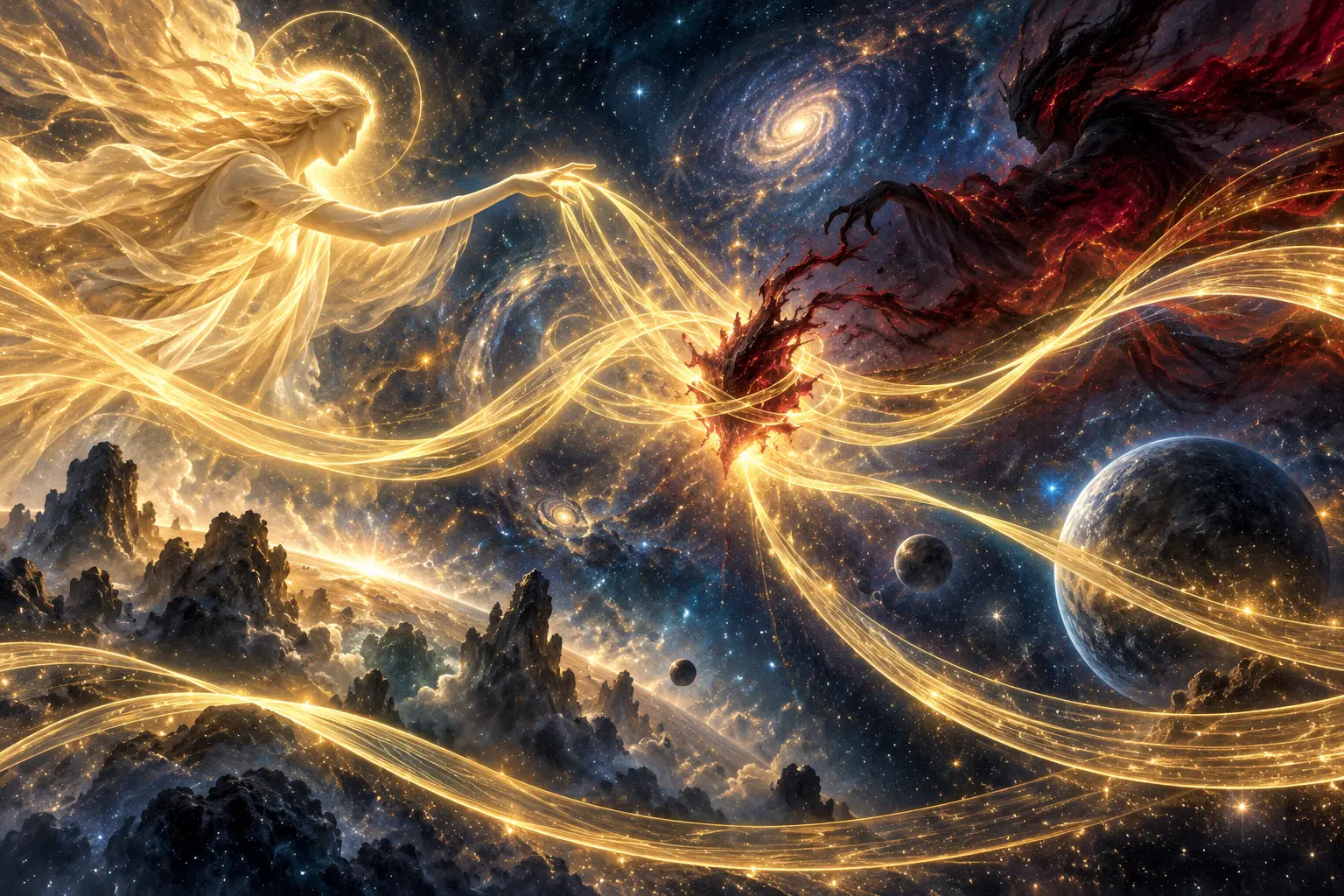
Before there are mountains, seas, Elves or Men, Tolkien begins with music. The Ainur sing themes given to them by Ilúvatar, and through their participation a vision of the world takes shape. Creation is neither mechanical nor solitary. It is received, interpreted and offered back.
Then Melkor introduces discord. He does not merely sing differently; he tries to draw the music towards himself. His desire is not to contribute a voice but to make the whole song answer to his will.
The difference between variety and discord
Tolkien’s harmony is not uniformity. The Ainur possess different powers, imaginations and emphases. Ulmo understands water with a depth others do not. Aulë delights in substance and making. Yavanna thinks towards growing things. Their distinctions enrich the music because each receives the theme without claiming ownership of it.
Melkor’s failure is therefore not individuality. It is self-centredness. He treats freedom as the right to detach his gifts from relationship and purpose. His music becomes loud because it cannot listen.
This pattern will echo throughout the legendarium. Sub-creation becomes destructive when the maker cannot release what has been made. Leadership becomes tyranny when stewardship gives way to possession. Knowledge becomes manipulation when it no longer serves truth.
Discord is not denied
Ilúvatar does not prevent Melkor from singing, nor does the final music pretend the discord never sounded. New themes arise in response to it, deeper and more sorrowful than what came before. The rebellion remains genuinely evil, yet it cannot escape the larger authority of the One who gave music its being.
This is not a simple claim that suffering is secretly good. Tolkien knew too much of grief to make that assertion. The discord wounds the world. Arda becomes marred, and its beauty will always carry loss. The hope lies elsewhere: evil is unable to become the ultimate author of meaning.
Providence does not make Melkor’s choices unreal. It means those choices cannot finally imprison creation within his intention. What he means for domination may become the occasion for courage, pity, endurance and forms of beauty that could not otherwise have been heard.
The humility of making
The Ainulindalë also speaks quietly to every act of human creativity. We receive languages, materials, traditions and experiences we did not originate. We shape them with our own voice, but we do not create from nothing. The healthiest making therefore contains both freedom and humility.
That balance is difficult. We can become possessive of our work, anxious to control how it is received or tempted to make every voice resemble our own. Tolkien’s music suggests another possibility: a work becomes richer when distinct voices listen deeply enough to belong together.
Discord will still enter. Plans fail, relationships fracture and beautiful things carry wounds. Yet the opening of The Silmarillion places all this within a story whose final meaning is not controlled by rebellion. The music is larger than the loudest interruption.
Reading: J.R.R. Tolkien, The Silmarillion, “Ainulindalë”.