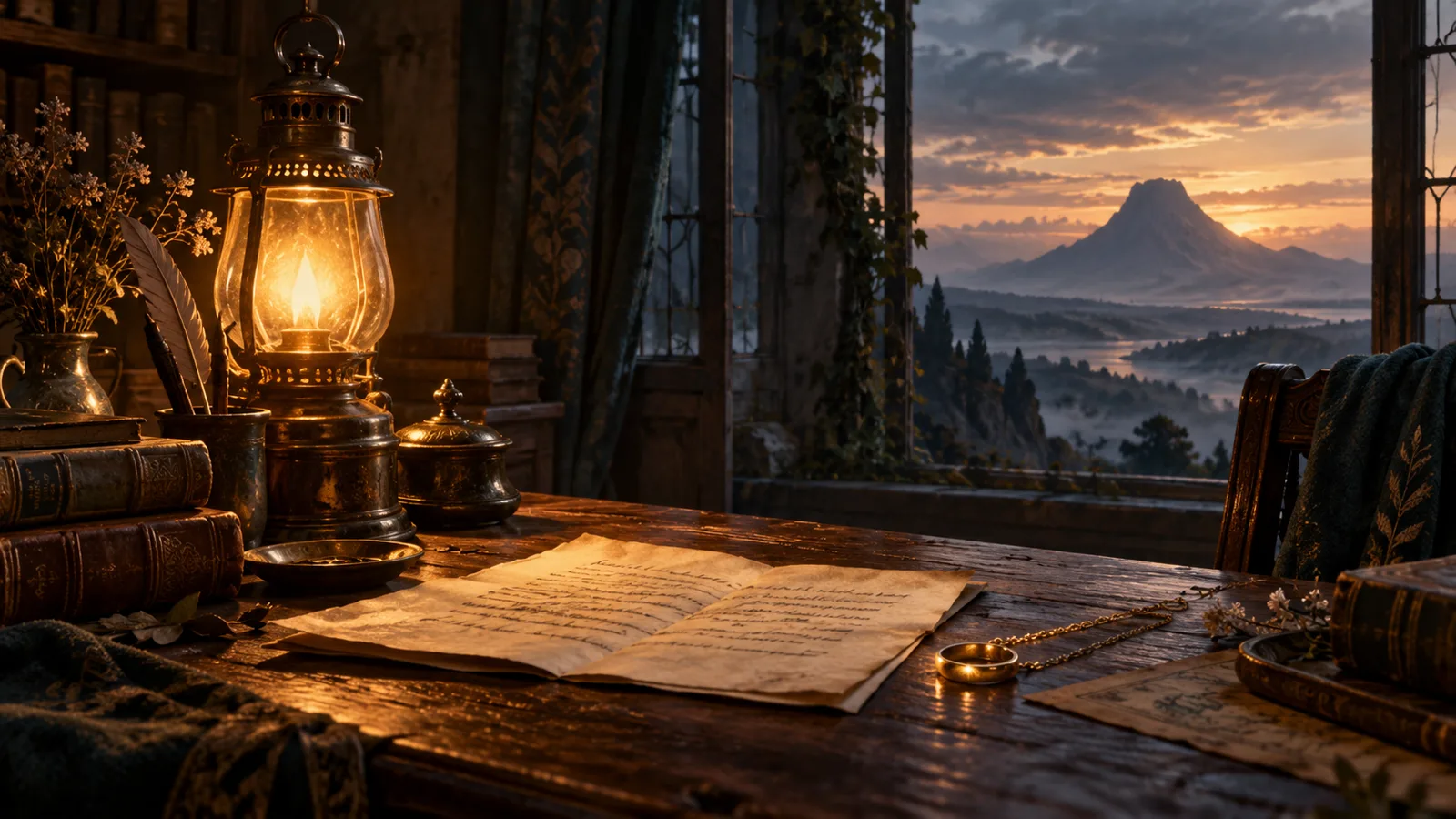
Frodo’s failure at Mount Doom is one of the most unsettling choices Tolkien could have made. The journey has carried him across half of Middle-earth, through terror, hunger and wounds that never fully close. He reaches the one place where the Ring can be unmade, stands above the fire, and does not release it. Instead, he claims it.
A simpler story would have allowed its hero one last gathering of strength. The music would rise, the hand would open, and endurance would receive its reward in a decisive act of will. Tolkien refuses that ending. The quest succeeds, but not because Frodo remains stronger than the burden until the final second.
In September 1963, Tolkien responded to Eileen Elgar, one of the few readers who had raised this apparent failure with him. His reply, published as Letter 246, does not evade what happened. Frodo did not complete the task as he had intended. Yet Tolkien writes, with striking clarity, “I do not think that Frodo’s was a moral failure.”
That sentence opens a humane and demanding vision of courage. It asks us to distinguish refusal from exhaustion, perfection from faithfulness, and an isolated final moment from the whole road that brought a person there.
The limit of endurance
By the time Frodo enters the Sammath Naur, the pressure of the Ring is at its greatest. He has carried it for months, often hungry, frightened and without any certainty that the quest can succeed. He has been stabbed by the Witch-king, poisoned by Shelob and steadily consumed by a burden that grows more powerful as it approaches the place of its making.
Tolkien tells Elgar that resistance at that final point would have been impossible for anyone, especially after long possession and such complete depletion. Frodo’s strength has not proved false; it has been spent. He has given everything it could give and arrived at the boundary beyond which it cannot carry him.
This matters because we often judge another person backwards from the moment when they finally fall. We see the missed appointment, the angry word, the abandoned task or the day they can no longer continue, and we let that visible breaking point define all that came before it. We may not see the months of fear, the repeated decisions to rise, or the quiet cost of holding together what had already become unbearable.
Compassion does not pretend that every choice is harmless. It does, however, ask what freedom remained in the moment we are judging. Tolkien does not call Frodo’s claim good; he asks whether a person crushed beneath an irresistible pressure should be condemned as though he had approached the fire rested, unburdened and entirely free.
The whole road belongs to the choice
Frodo’s moral story cannot be reduced to the few seconds in which he puts on the Ring. It includes his willingness to leave the Shire, his offer at the Council of Elrond, his refusal to answer violence with needless cruelty and every step taken after hope has ceased to feel convincing. He does not arrive at Mount Doom by accident. He arrives because he has consented, again and again, to bear what he cannot master.
Tolkien’s explanation does not lower the meaning of heroism; it relocates it. Heroism is not proved only by an immaculate ending. It may lie in spending oneself faithfully enough to bring the story to a place where an ending becomes possible, even when that person cannot perform the final act alone.
Sam understands something of this before anyone writes an account of the quest. On the slopes of Orodruin, he cannot carry the Ring, but he can carry Frodo. The distinction is important. Love does not remove the burden by denying its reality. It draws near to the one who bears it and gives the strength that can still be given.
Mercy prepared the ending
The Ring is destroyed because Gollum takes it and falls into the fire. On the surface, this can look like a fortunate accident added when Frodo’s courage fails. Yet the ending has been prepared by mercy long before Mordor.
Bilbo spared Gollum beneath the Misty Mountains. Frodo later resisted the desire to have him killed, even when Gollum was dangerous, treacherous and miserable company. Neither Hobbit showed mercy because he could calculate how it would rescue the quest. They did so because pity recognised that judgement did not belong entirely to them.
Those merciful choices do not make Gollum good, and they do not make his treachery unreal. They leave open a possibility that power would have closed. When every planned strength is exhausted, the consequence of mercy remains present within the story.
This is why the destruction of the Ring is neither a reward Frodo earns nor a random rescue that makes his labour irrelevant. He has brought the Ring to the only place where it can be destroyed, and the pity shown along the road has preserved the creature through whom its destruction finally comes. Endurance and mercy meet at the edge of human—or Hobbit—ability.
Providence without control
Tolkien describes Frodo in the letter as an instrument of Providence, but this does not mean Frodo is a puppet or that his suffering is merely a mechanism. His choices remain truly his. Providence works through them without becoming something he can command.
That is one reason the ending resists both despair and triumphalism. Frodo cannot boast that his will destroyed the Ring; nor must he conclude that everything was worthless because his will finally broke. The good outcome gathers up acts of courage and pity whose full meaning no character could see when they were performed.
We often want providence to mean a clear promise that sincere effort will produce the result we desire. Tolkien offers something less manageable and more hopeful. Faithfulness matters even when it cannot finish the story by itself. Mercy may bear fruit beyond our sight. A person may reach the end of strength without reaching the end of grace.
Honour after failure
Frodo returns to the Shire honoured, but he does not return untouched. The public celebration cannot erase Weathertop, Shelob’s sting or the inner wound of the Ring. He helped save his home and finds that he cannot fully live within the peace he preserved for others.
Letter 246 treats this with the same tenderness it gives the scene at the fire. Tolkien does not offer the journey West as immortality or a simple reward. It is the hope of healing, a period of peace and redress before Frodo’s mortal life reaches its natural end. The one who carried the wound is not asked to prove his worth by pretending he no longer has it.
There is wisdom here for the way we honour those who have spent themselves. We should not praise sacrifice while ignoring its cost, or celebrate what someone achieved while leaving them alone with what the achievement required. Gratitude makes room for rest, care and grief. It does not demand that the wounded look victorious for our comfort.
Frodo’s story is not diminished because he cannot cast the Ring away. It becomes more truthful. Courage can be complete without being limitless, and a life can be faithful even when its final strength is not enough.
At Mount Doom, Frodo reaches the end of himself. But because he has endured, because mercy has been given, and because providence is larger than any one will, the end of himself is not the end of hope.
Source note: J.R.R. Tolkien, Letter 246, a draft letter to Eileen Elgar dated September 1963, published in The Letters of J.R.R. Tolkien, edited by Humphrey Carpenter with Christopher Tolkien. The central passage is also published by The Tolkien Estate. This reflection uses one brief quotation and otherwise summarises Tolkien’s argument. Narrative references come from The Lord of the Rings, especially “Mount Doom” and “The Grey Havens”.