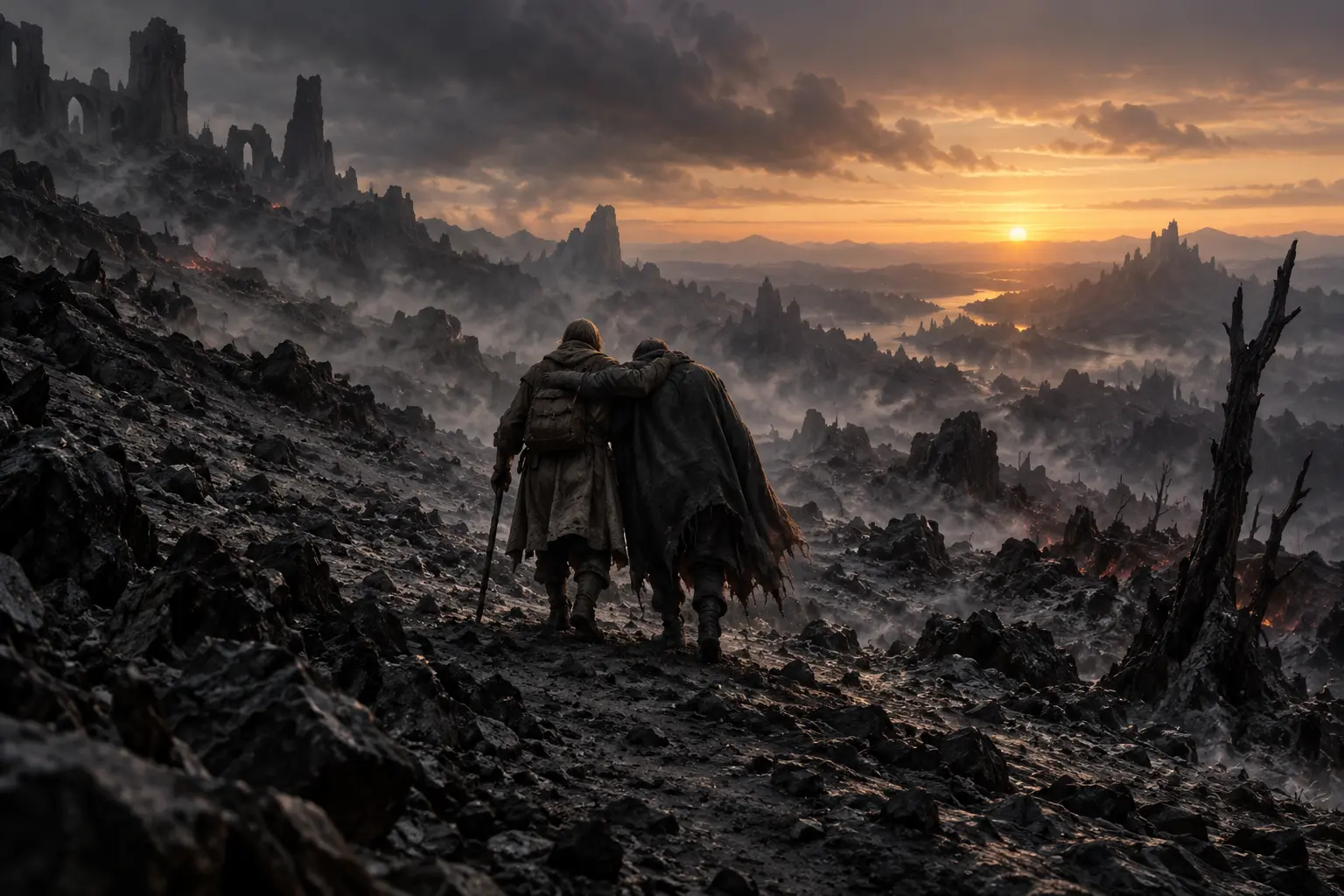
“I can’t carry it for you, but I can carry you and it as well.”
By the time Sam speaks these words, grand language has almost disappeared from the story. There are no armies on the slopes of Mount Doom, no banners and no songs of victory. There are only two Hobbits in a ruined land, one of them unable to continue and the other finally understanding that he cannot take the burden away.
Sam cannot carry the Ring. That task belongs to Frodo, with all the loneliness and suffering it has brought him. But love discovers another possibility. Sam can carry the bearer.
Courage without spectacle
Tolkien gives Sam moments of visible bravery, yet his deepest courage has been forming through hundreds of quieter decisions. He listens when Frodo cannot speak. He prepares food in places where comfort has nearly vanished. He keeps watch, remembers the Shire and holds on to a future neither of them can reasonably expect to see.
This is courage as attention. Sam notices what another person needs and acts before the moment can become a story about himself. His strength is not the absence of fear, exhaustion or doubt. It is the refusal to let those things sever the bond he has chosen to keep.
There is an important humility in his words. Sam does not promise to fix everything. He names the limit honestly: he cannot carry the Ring. Love does not grant him control over Frodo’s calling, wounds or choices. What it grants him is a way to remain present within those limits.
The gift of being carried
Many of us find it easier to imagine ourselves as Sam than as Frodo. We prefer to be the one offering strength. Yet Tolkien’s scene also honours the vulnerability of being carried. Frodo must allow another person to bear his weight when his own strength has failed. That is not defeat. It is one of the forms fellowship takes.
The road to Mount Doom could never have been completed by solitary heroism. Frodo bears what Sam cannot; Sam supplies what Frodo no longer possesses. Their different forms of faithfulness meet at the point where each alone would be insufficient.
Much of life is lived in that same space. We cannot remove another person’s grief, illness, responsibility or fear. We may be unable to offer an answer that changes their circumstances. But we can prepare the meal, make the call, sit through the silence, carry the practical weight and return tomorrow.
Sam’s courage stays because it is rooted in love rather than recognition. He does not know whether anyone will remember the climb. He knows only that Frodo must not make it alone.
Source: J.R.R. Tolkien, The Lord of the Rings: The Return of the King, Book VI, Chapter 3, “Mount Doom”.