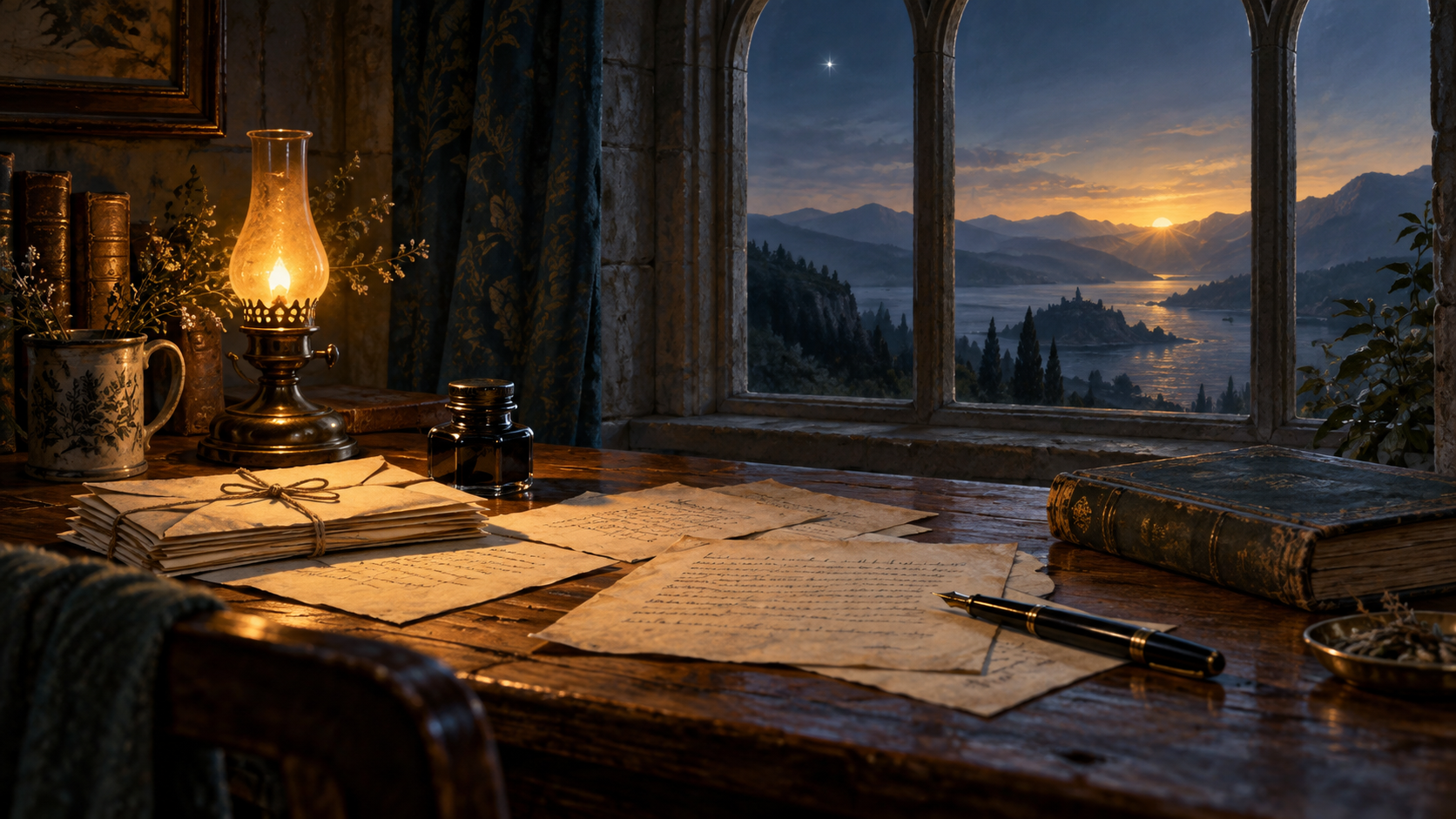
Long before anyone knew whether readers would follow him all the way from the Shire to the fire of Mount Doom, J.R.R. Tolkien sat down to explain the world he had been building for most of his life. The result was a remarkable letter sent in 1951 to the publisher Milton Waldman: part history, part artistic confession, and part attempt to gather an immense and tangled mythology into words another person might understand.
There are grand things in that letter. Tolkien speaks of languages, legends, Elves, mortality, power and the desire to create. Yet when he reaches The Lord of the Rings, the centre of gravity shifts. The tale may contain kings returning from exile, ancient peoples passing out of the world and powers whose struggles reach back beyond recorded history, but Tolkien tells Waldman that this final great story is seen chiefly through the eyes of Hobbits.
That choice was not merely a way of making an intimidating mythology easier to enter. It carried one of Tolkien’s deepest convictions about courage: history is not moved only by those whom history has already decided to call great.
A world seen from below
Middle-earth is full of figures who appear fitted for legend. Aragorn is the heir of Isildur. Gandalf is one of the Istari, sent into Middle-earth from beyond the Sea. Galadriel has seen the light of the Two Trees, Elrond carries the memory of ages, and even the enemies of the West possess a scale and terror far beyond the lives of ordinary people.
Then, among all this inherited greatness, Tolkien places Frodo Baggins: a quiet country gentleman from a land so overlooked that many of the Wise know almost nothing about it. Beside him stands Samwise Gamgee, a gardener whose knowledge of potatoes is more immediately useful to him than the histories of Númenor. Merry and Pippin begin as companions who scarcely understand the road they have chosen.
They are not secretly warriors. They do not discover that they possess some hidden force equal to Sauron’s. The longer the journey continues, the more clearly we see their vulnerability. They hunger, they become frightened, they make mistakes, and they are wounded in ways that cannot simply be undone when the battle is over.
Yet this is precisely why their presence matters. Tolkien was not interested in pretending that smallness was another kind of worldly strength. He was interested in what becomes possible when people without power choose pity, loyalty and endurance.
The unforeseen act
In his letter to Waldman, Tolkien describes a recurrent theme in his work: the place of “unforeseen and unforeseeable acts of will.” The phrase is brief, but it illuminates the whole movement of The Lord of the Rings.
The powers of Middle-earth make plans. Sauron calculates what his enemies will do because he understands the desire for power. Saruman prepares armies and machinery. Denethor looks into the palantír and believes he has seen enough of the world to know how its story must end. Even the wise and the good must take counsel, judge dangers and choose their roads.
But the decisive moments repeatedly arise beyond calculation. Bilbo spares Gollum beneath the Misty Mountains. Frodo volunteers at the Council of Elrond when the strong fall silent. Sam returns to his master rather than surrendering to despair. Faramir refuses the Ring when taking it might seem to serve the defence of his city. Éowyn stands between Théoden and the Witch-king when every visible measure of strength says she cannot prevail.
None of these choices guarantees success. That is what makes them acts of moral freedom rather than pieces moving according to a visible design. Their importance is often hidden from the person making them. Bilbo does not spare Gollum because he has foreseen the Cracks of Doom. Sam does not carry Frodo because he understands the whole shape of providence. They do the merciful or faithful thing that lies before them, while the ending remains beyond their sight.
Heroism at a pinch
Tolkien tells Waldman that Hobbits possess no non-human powers and are unusually free from ambition and greed. Their physical smallness allows him to reveal what he calls the “amazing and unexpected heroism” of ordinary people when the moment of testing comes.
This is not heroism as performance. The Hobbits rarely sound heroic to themselves. Sam’s courage grows out of love for Frodo, memories of home, the stubborn refusal to abandon what has been entrusted to him, and the belief that some things remain worth doing even when success appears impossible. Frodo’s courage is not invulnerability, but consent to carry a burden that steadily diminishes him. Merry and Pippin grow not by leaving their ordinary nature behind, but by discovering how much faithfulness that nature can hold.
There is something profoundly hopeful here. If Tolkien’s story belonged only to the exceptionally gifted, we might admire it while remaining safely outside it. But a story entrusted to Hobbits quietly turns towards us. Most lives are not lived upon thrones or battlefields. Most acts of courage are not witnessed by chroniclers. They happen in kitchens, hospital rooms, workshops, gardens and ordinary homes; in promises kept after enthusiasm has faded; in mercy offered when resentment would be easier; in one more step taken when no triumphant ending can yet be seen.
The small are not sufficient alone
Tolkien does not romanticise ordinariness by making greatness unnecessary. In the same letter, he insists that the noble and the simple need one another. Frodo could not reach Mordor without Aragorn, Gandalf, Elrond and all those who openly resist Sauron. Yet their strength alone cannot win the war. The armies before the Black Gate can only create an opening for two exhausted Hobbits crawling across a wasteland.
This interdependence protects Tolkien’s vision from becoming sentimental. The small are not powerful because power is secretly unimportant, and the great are not diminished so that the ordinary may be praised. Rather, each form of faithfulness receives its meaning through the other. Aragorn’s courage draws the Eye away from Frodo. Frodo’s hidden journey makes Aragorn’s stand more than a noble defeat. Sam carries Frodo, while countless people he will never meet hold back the darkness long enough for him to do it.
The victory, when it comes, cannot be possessed by any single hero.
What Tolkien asks us to notice
Perhaps this is why the Hobbits remain so close to the heart of readers. They allow us to enter a world of immense beauty without asking us to pretend that we are grander than we are. Their courage begins within the limits of ordinary life, and it retains the memory of that life even at the end of all things. Sam can look into the darkness above Mordor and notice a star. Frodo can remember the taste of strawberries. The Shire can remain present, not as an escape from duty, but as the reason duty matters.
Tolkien’s letter reminds us that the most important deed in a life may not look important when it is done. We may not know what depends upon a small mercy, a refusal to surrender, or the decision to remain beside someone who cannot continue alone. We are rarely shown the whole design. We are given only the next choice.
And in Middle-earth, as in our own world, providence so often works through people who do not imagine that history is watching.
Source: J.R.R. Tolkien’s 1951 letter to Milton Waldman, published by The Tolkien Estate. The two brief quotations above are taken from that letter. This is an independent reflection and is not affiliated with the Tolkien Estate.