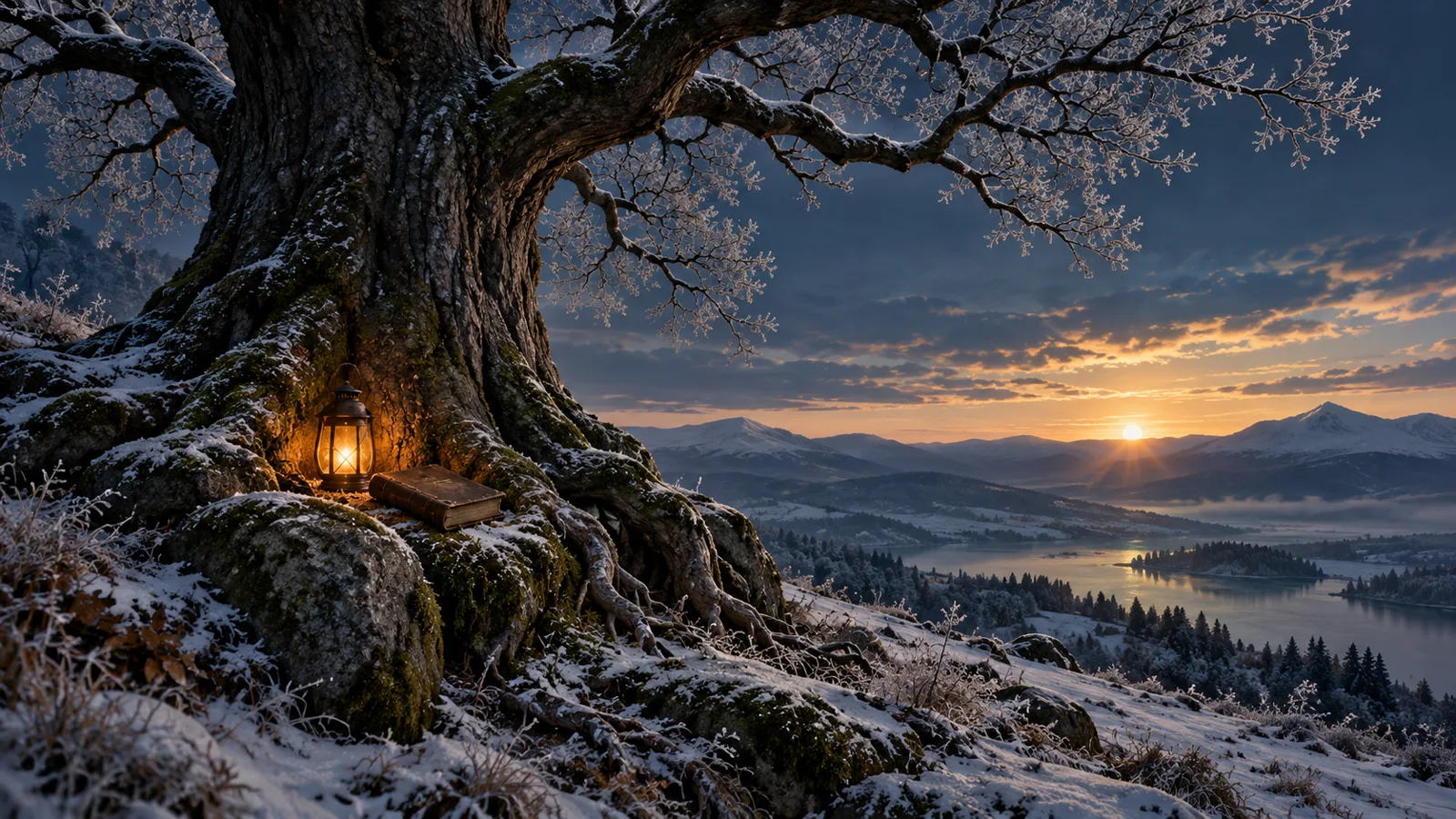
“Deep roots are not reached by the frost.”
The line belongs to Bilbo’s “Riddle of Strider”, copied into Gandalf’s letter so that Frodo might recognise the Ranger he meets at Bree. The poem describes Aragorn through a series of reversals: what appears weathered may still be strong, what has been broken may be renewed, and the wanderer without a crown may yet be a king.
Frost is an image of hardship, but also of mistaken judgement. In winter, the life of a tree withdraws from sight. Leaves have gone, fruit has ceased and branches stand bare against the sky. If we judged only by what was visible, we might think the tree had lost everything that made it alive.
The roots tell another story.
The strength formed in hidden years
Aragorn’s strength is not created at the moment he enters Minas Tirith. It has been formed through long years of service without recognition: guarding borders, travelling under other names, learning the histories of his people and choosing responsibility before any throne is offered to him.
The crown eventually reveals who he is, but it does not make him worthy. His hidden life has already done that work.
We often long for visible signs that our lives are moving forward. We want the changed circumstance, the completed task, the acknowledgement that our effort has mattered. Yet many of the things that sustain us are built before there is anything impressive to show: habits kept in quiet rooms, prayers spoken without feeling, skills practised badly before they become useful, friendships tended when no crisis makes them urgent.
Roots grow in darkness. That is not evidence that nothing is happening.
What the frost can and cannot do
Tolkien does not promise that deep roots prevent winter. Aragorn loses his father as a child, inherits a broken kingdom and spends much of his life among people who do not know his true name. Rootedness does not make him untouched by grief or uncertainty. It keeps those things from deciding who he will become.
There are seasons when our visible life seems diminished. Work is interrupted, plans fail, health changes, confidence recedes, and the gifts that once felt fruitful appear to have gone quiet. In such times, endurance may not look like forward motion. It may look like remaining connected to what is true: the people we love, the promises we have made, the faith that held us before we knew how severe the winter would be.
This is not a demand to appear strong. A tree does not deny the frost by keeping its leaves. It survives because its life is held more deeply than the cold can reach.
The quiet work of becoming rooted
Deep roots are formed slowly. They come from returning to good things until those things become part of us: telling the truth when concealment would be easier, receiving wisdom from those who walked before us, allowing trusted friends to know us, and practising hope before we desperately need it.
None of this gives us control over the weather. It gives us somewhere to stand within it.
Bilbo’s riddle looks beyond Strider’s worn cloak without dismissing the years that wore it. The hidden king is not waiting for life to begin; he is already becoming the person who will be able to carry the crown.
Winter may change what can be seen. It may require patience, shelter and the grace to accept a season without fruit. But it does not have the final word over a life whose roots have gone deep.
Spring is not yet visible. The roots remain.
Source note: J.R.R. Tolkien, The Lord of the Rings: The Fellowship of the Ring, Book I, Chapter 10, “Strider”. The quotation is one line from “The Riddle of Strider”, composed by Bilbo about Aragorn and included in Gandalf’s letter to Frodo.