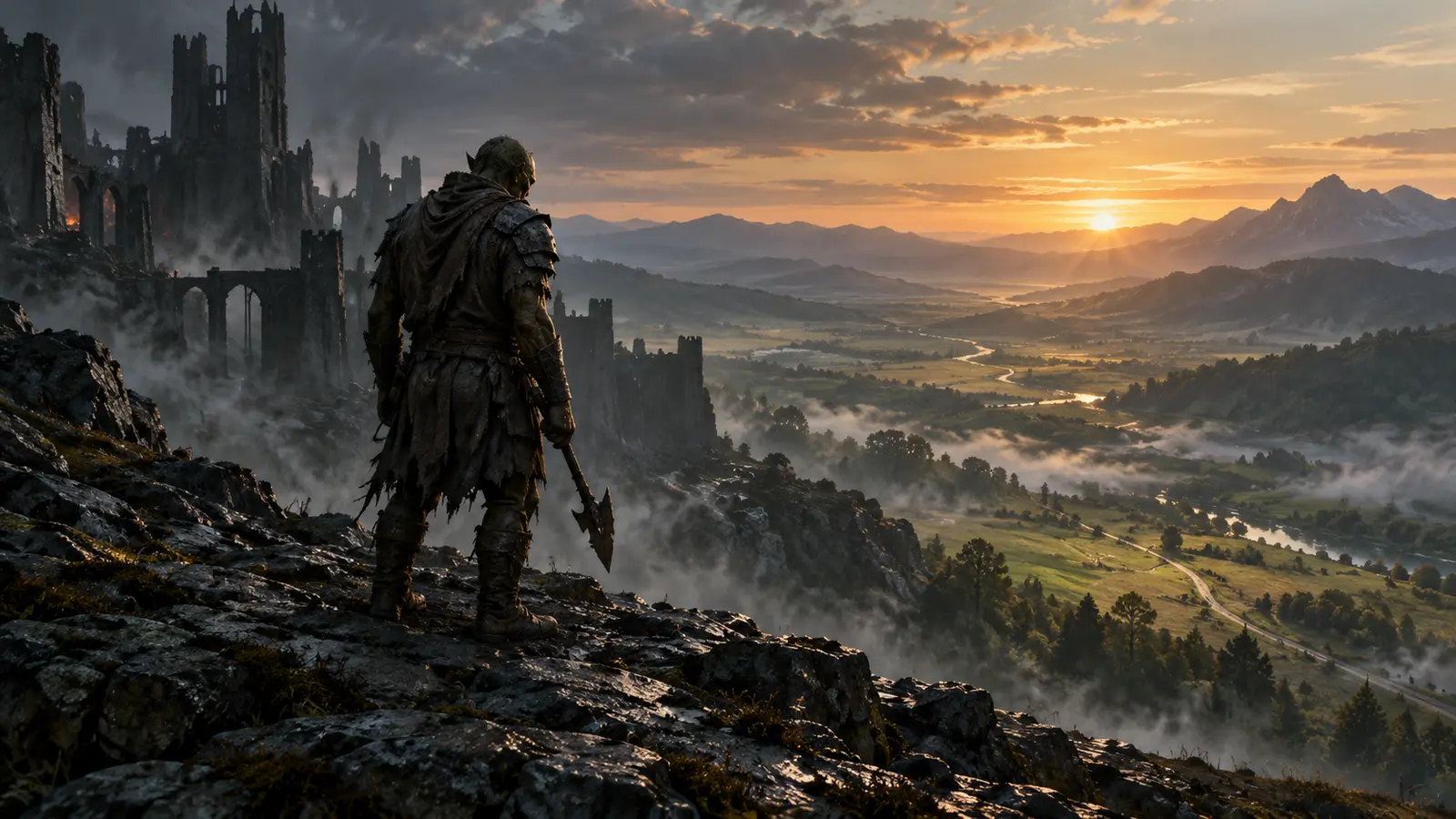
Orcs appear throughout Tolkien’s stories as servants of darkness: violent, mocking, quarrelsome and cruel, marching beneath the will of Morgoth or Sauron and leaving ruined lands behind them. They are the enemy at the gate, the army in the pass, the nameless threat pouring across the field. In the immediate urgency of the story, there is little time to wonder what any one of them might have been before the Shadow claimed him, or whether another road could ever remain open.
Tolkien did wonder. The more seriously he considered the moral foundations of Middle-earth, the less comfortable he became with a race of speaking, reasoning creatures who could simply be declared evil without remainder. If Orcs could think, argue, fear, resent domination and make choices, then they could not be treated as machines wearing flesh. Yet if they possessed freedom, even in a terribly damaged form, the possibility of moral responsibility—and perhaps of mercy—could not be dismissed.
In an unsent draft written to Peter Hastings in September 1954, published as Letter 153, Tolkien approached that difficulty and left behind a revealing moment of self-correction. He nearly called the Orcs “irredeemably bad”, then wrote that this would be “going too far”.
The pause matters as much as the conclusion.
A sentence Tolkien could not complete
Hastings, the manager of a Catholic bookshop in Oxford, had admired The Lord of the Rings but questioned some of its metaphysical ideas. Among his concerns was Treebeard’s statement that the Dark Lord had made Orcs and Trolls. For Tolkien, the word made carried an enormous weight. Evil could distort, enslave and imitate, but it could not bring genuinely independent life into being from nothing. True creation belonged to the One.
This meant that Orcs could not be explained as wholly new creatures manufactured by Morgoth in the way a smith produces weapons. If they were alive in the deepest sense—if they possessed minds and wills—then their existence must ultimately depend upon a good creation that had been violated rather than replaced.
Tolkien’s near-use of irredeemable shows the pressure of the problem. Orcs are presented as naturally bent towards evil, and the stories offer no clear example of an Orc turning toward goodness. Still, he could not make corruption absolute. However terrible the damage, to say that a rational creature was beyond every possibility of restoration would give evil a finality Tolkien was unwilling to grant it.
The Dark Lord could deform a life. He could not become its deepest author.
Corrupted, not created
This conviction helps explain why Tolkien never settled on one fully satisfactory origin for the Orcs. At different stages he explored several possibilities: that they descended from Elves captured and corrupted by Morgoth, that Men lay closer to their beginnings, that some might have been beasts given a counterfeit appearance of reason, or that lesser spirits had entered Orc-like forms. Each solution answered one difficulty and created another.
If Orcs were only clever animals or puppets, their speech, organisation and moral complaints became difficult to explain. If they descended from Elves or Men, then they belonged among the rational peoples of the world, and the consequences of that belonging could not be ignored. They might be horribly corrupted, but they would not be a separate kind of life whose suffering or death possessed no moral significance.
The uncertainty is not a failure of imagination. It is evidence that Tolkien would not solve a narrative convenience by violating the deeper moral laws of his world. He needed dangerous enemies for his wars, but he also believed that evil was parasitic: it fed upon good things, twisting courage into brutality, order into tyranny and fellowship into obedience through fear.
Orcs embody that twisting more starkly than any other people. They are not proof that darkness can create its own world. They are evidence of what darkness does to a world it did not make.
Freedom beneath the Shadow
The Orcs we overhear in The Lord of the Rings are not silent extensions of Sauron’s mind. Shagrat and Gorbag complain about their commanders, distrust each other, remember earlier orders and imagine escaping the great powers who use them. Their dream is hardly noble; freedom, as they picture it, would still involve raiding and violence. Yet the conversation reveals private desire beneath military obedience. They know they are being spent for someone else’s purpose.
That small glimpse makes the moral question harder. A will can be real without being healthy. A person formed within cruelty may make cruel choices while also bearing wounds, fears and habits imposed long before those choices became possible. Tolkien does not excuse the harm Orcs cause, but neither does he allow domination to become morally invisible.
In later reflections gathered in Morgoth’s Ring, he imagined the Orcs under a pressure so severe that their ability to resist the Dark Lord was almost extinguished. Morgoth, and later Sauron, could press upon them with a central will that reduced their lives towards obedience. This was not innocence; Orcs still acted with malice and often delighted in cruelty. But it meant that judgement could not be separated from the conditions under which their wills had been bent.
Freedom survives here not as easy independence, but as a damaged capacity almost buried beneath fear. Tolkien’s question was not whether Orcish deeds were evil. It was whether the Shadow had the right to define the whole truth of the creatures it had enslaved.
Mercy in a merciless war
Tolkien’s later notes carry the question beyond speculation into conduct. In a discussion of Orcs among the “Myths Transformed” texts, he wrote that the Wise taught that Orcs had not been created evil by Melkor. Therefore, although they had to be resisted with severity in war, they were not to be treated according to their own standards of cruelty. Captives were not to be tortured, and an Orc who surrendered and asked for mercy was to receive it, even at cost.
That distinction is essential. Mercy does not pretend that evil is harmless, nor does it require the free peoples to allow themselves to be destroyed. The Wise may fight the servants of Morgoth because homes, children and the freedom of whole peoples are at stake. But necessity does not grant permission to become like the enemy.
The rule protects more than the captive. It protects the victor from accepting the lie that power decides whose dignity remains. Once cruelty is justified by the ugliness of its target, the moral difference between defence and domination begins to disappear.
We see the same pattern elsewhere in Tolkien’s work. Frodo forbids vengeance during the liberation of the Shire. Faramir refuses to delight in killing even when war is necessary. Aragorn heals former enemies and restores order without making humiliation the purpose of victory. Mercy does not erase justice. It keeps justice from being consumed by hatred.
An unresolved question honestly kept
Tolkien never wrote the tale of an Orc who clearly rejected the Shadow and sought a different life. Nor did he settle, once and for all, the problem of Orcish origins. His letters and late notes preserve alternatives, revisions and tensions rather than one neat canonical answer.
That incompleteness may frustrate readers who want the legendarium to function like a closed system. Yet there is wisdom in Tolkien’s refusal to force certainty where his convictions and his storytelling pulled in different directions. He had created enemies who carried the imagery of total corruption, then recognised that their speech and reason raised questions his mythology could not responsibly avoid.
Instead of hiding the difficulty, he allowed it to remain. The result is not a simple declaration that every Orc would be redeemed, or even that any one of them would choose redemption. It is a boundary placed around despair: Tolkien would not confidently say that restoration was impossible.
Hope sometimes begins there—not in knowing how a ruined will might be healed, but in refusing to close the door that evil itself did not build.
The danger of writing anyone off
The Orcs are not a direct allegory for any human people, and they should never be used as one. Their value for reflection lies elsewhere: they expose the temptation to turn moral judgement into a total account of another person. Once someone has harmed us, frightened us or joined themselves to a destructive cause, we may begin to speak as though the worst truth about them is the only truth, and as though their history, freedom and future belong entirely to the darkness we can see.
Tolkien’s hesitation warns against that certainty. To believe that no person is irredeemable is not to deny responsibility, abandon boundaries or call cruelty good. It is to admit that judgement has limits, that corruption is not creation, and that we do not possess the authority to declare the final end of another soul.
This is difficult hope because it offers no sentimental picture of change. Tolkien gives us no reformed Orc community waiting beyond Mordor, and ordinary life gives us no guarantee that everyone offered mercy will receive it. Saruman rejects mercy. Gollum betrays pity again and again. Many wills remain closed.
Yet mercy is not made foolish by refusal. It bears witness to a truth the refusal cannot overturn: evil may occupy a life without becoming the source of that life’s worth.
A possibility left open
Could Orcs be redeemed? Tolkien never gave us a finished answer. He gave us something quieter and, perhaps, more demanding: a reason not to answer too quickly.
The Orcs remain responsible for dreadful deeds. The free peoples remain right to resist them. But the Shadow that enslaves and deforms them is not permitted the dignity of being called a creator, and its victims are not reduced without remainder to the purposes it imposed upon them.
In Letter 153, Tolkien’s pen stops before the word irredeemable can become final. In that pause we hear the moral depth of Middle-earth: justice without cruelty, resistance without hatred, and hope that refuses to call darkness everlasting.
Not every question needs to be closed. Some are kept open so mercy still has somewhere to enter.
Source note: J.R.R. Tolkien, Letter 153, an unsent draft to Peter Hastings written in September 1954, published in The Letters of J.R.R. Tolkien, edited by Humphrey Carpenter with Christopher Tolkien. The discussion of mercy towards surrendered Orcs and their domination by Morgoth and Sauron draws on “Myths Transformed” in Morgoth’s Ring, edited by Christopher Tolkien. Narrative examples are from The Lord of the Rings, especially “The Choices of Master Samwise” in The Two Towers. Only two very short phrases from the letter are reproduced.